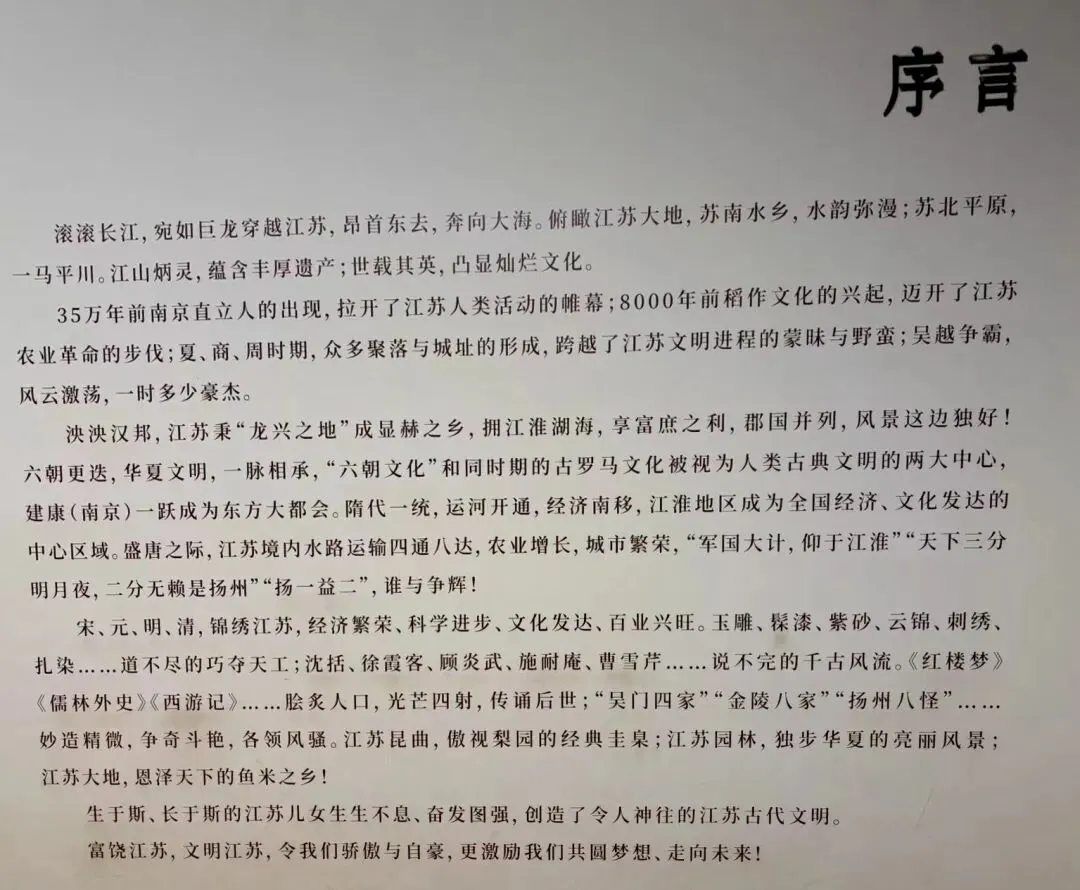
泱泱汉邦,江苏秉“龙兴之地”,成显赫之乡,拥江河湖海,享富庶之利,郡国并列,风景这边独好!六朝更迭,华夏文明,一脉相承,“六朝文化”和同时期的古罗马文化被视为人类古典文明的两大中心,建康(南京)一跃成为东方大部会。隋代一统,运河开通,经济南移,江淮地区成为全国经济、文化发达的中心区城。盛唐之际,江苏境内水路运输四通八达,农业增长,城市繁荣。“军国大计,仰于江淮”“天下三分明月夜,二分无赖是扬州”“扬一益二”,谁与争辉!
Jiangsu rose to prominence during the Han dynasty (202 BC – 220 AD) as the birthplace of the founding emperor. The ensuing Six Dynasties period (222 – 589 AD) witnessed the ascension of Jiangsu as a lively cultural hub comparable to Ancient Rome. Nanjing (Jiankang) became known as the 'Metropolis of the East'. The Sui dynasty (581 – 618 AD) reunited China under its rule and launched the construction of the Grand Canal, which prompted China's economic centre to shift to the southern provinces. By the heyday of the Tang dynasty (618 – 907 AD), Jiangsu boasted extensive transportation networks both over water and on land, which further accelerated agricultural and urban development in the region.
The great Han realm saw Jiangsu rise as a “dragon’s thriving land” — a splendid region blessed with rivers, lakes, and seas, enjoying prosperity and abundance, where commanderies and kingdoms coexisted in a landscape of unrivaled beauty. Through the succession of the Six Dynasties, the Chinese civilization flowed in an unbroken lineage; the “Six Dynasties culture”, together with its contemporary Roman culture, is regarded as one of the two great centres of classical human civilisation, and Jiankang (Nanjing) emerged as a great metropolis in the East. With reunification under the Sui Dynasty, the Grand Canal was opened, the economic centre shifted southward, and the Yangtze-Huaihe region became a nationally prominent centre of economy and culture. In the heyday of the Tang Dynasty, Jiangsu enjoyed a well-connected network of waterways, agricultural growth, and thriving cities. “Major state affairs relied on the Yangtze-Huaihe region.” “If the moonlight of the whole world be divided into three parts, two parts would be the loveliness of Yangzhou.” “Yangzhou first, Yizhou second” — who could rival such splendour!
首先,外宣翻译对原文进行了大胆而合理的信息筛选与重组,聚焦核心历史脉络。原文以浓墨重彩的修辞铺陈了江苏的荣耀国王,包含多处夸饰性表达,以及三处诗词引用。外宣翻译将这些华丽但信息密度较低、文化背景复杂的内容全部省略或凝练,仅保留最具辨识度的史实骨架:汉朝作为帝王发祥地、六朝文化比肩古罗马、隋朝运河与经济南移、唐朝水陆交通与城市繁荣。这种“去装饰化”的处理,避免了外国读者因文化隔阂而产生的困惑,使信息传递更加高效、清晰。
其次,外宣翻译将原文中抽象、比喻性的表达减去,为英语读者提供容易理解的具体事实。例如,原文“秉‘龙兴之地’”中的“龙”是中国特有的文化符号,直译会造成误解。外宣翻译处理为 “the birthplace of the founding emperor”(开国皇帝的出生地),直接点明历史事实,清晰准确。原文“六朝文化”与古罗马文化并称为“两大中心”,外宣翻译用 “comparable to Ancient Rome”(可与古罗马媲美)来传达同等地位。
再者,外宣翻译做加法,为外籍游客贴心地标注了年代和专有名词。每个朝代均附有起止年份(如 Han dynasty (202BC~220AD)),并且将原文的“建康”同时标注为“Nanjing (Jiankang)”,帮助外国读者将历史地名与现代认知对应起来。这种细节体现了外宣翻译“以读者为中心”的考量。
南博的外宣翻译,做的是巧妙的“加减法”——减法,是删去外国观众看不懂的铺陈感叹,只把最核心的意思说清楚;加法,是贴心补充朝代的具体年代,让外国读者一眼看清历史的坐标。
一减一加之间,历史的意义的由此抵达。