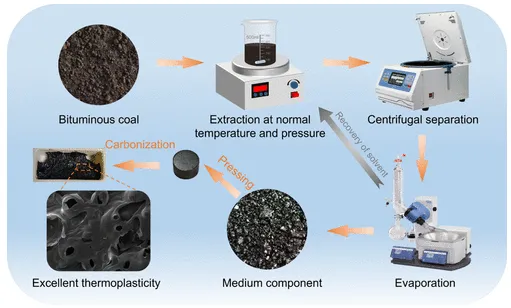
图1. Extraction process and foaming flow of the medium component.
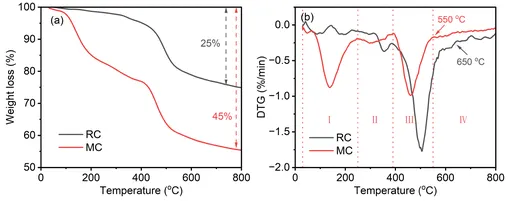
图2. (a) TG and (b) DTG curves of the RC and MC.
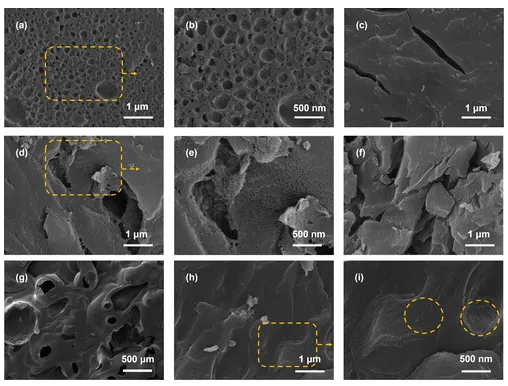
图3. SEM images of (a–b) AC, (c) CAC-450, (d–e) CAC-550, (f) CAC-650, (g) CMC-550, and (h–i) CS-550.
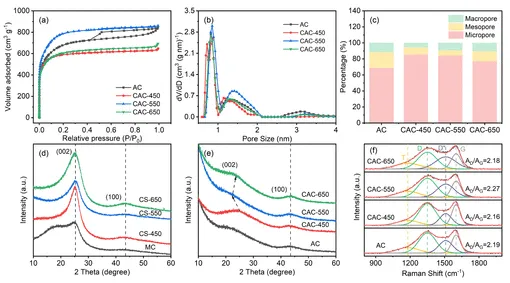
图5. (a) N2 adsorption–desorption isotherms of AC and CACs, (b) pore size distributions of AC and CACs, (c) percentage of pore distribution, (d) XRD patterns of MC and CSs, (e) XRD patterns of AC and CACs, and (f) Raman spectra of AC and CACs.
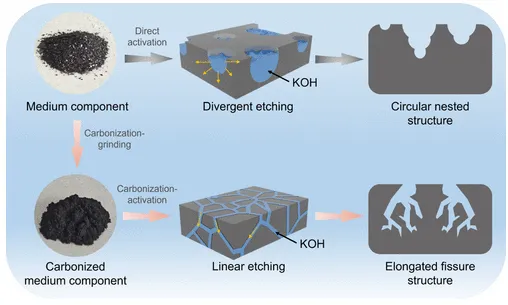
图6. Mechanism of porous carbon morphology formation under different KOH activation pathways.
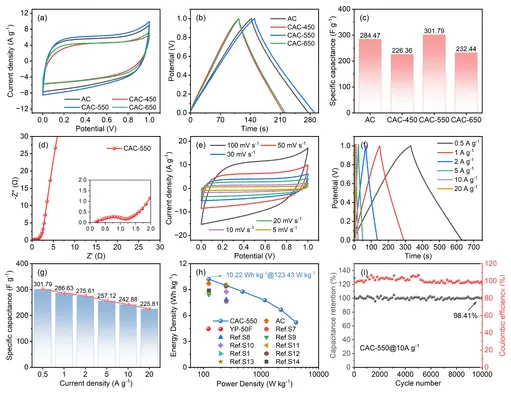
图7..Electrochemical performance in symmetrical two-electrode systems: (a) CV curves at 50 mV s–1, (b) GCD curves at 1 A g–1, (c) comparison of the specific capacitance of the device at 0.5 A g–1, (d) Nyquist plot, (e) CV curves and (f) GCD curves of CAC-550, (g) specific capacitance of PC-14 at different current densities, (h) Ragone plots, and (i) cycling stability.
综上所述,通过烟煤的混合溶剂萃取获得了无灰煤基介质组分。通过改变KOH的活化途径诱导前驱体流动性差异,制备出具有嵌套状和裂隙状形态的两种多孔碳材料。结果表明,优化碳化温度可有效调控多孔碳的孔道发育与晶体结构。最优裂隙型分级多孔碳(CAC-550)展现出最高无序结构和最大比表面积(2958.55 m² g⁻¹)。在三电极体系中作为电极材料时,其在0.5 A g–1电流密度下实现438.12 F g–1的比电容,即使在20 A g–1高电流密度下仍保持323.51 F g–1的比电容,容量保持率达73.84%。组装的对称超级电容器在0.5 A g–1电流密度下表现出301.79 F g–1的比电容,经10 A g–1电流密度10,000次循环后仍保持98.41%的电容值,并在123.43 W kg–1功率密度下实现10.22 Wh kg–1的能量密度。本研究为煤炭的清洁高效利用提供了创新策略,充分展现了煤基多孔碳作为超级电容器电极材料的巨大应用潜力。