课程时间
Workshop Time
2026.5.18-2026.5.22
课程主题
Workshop Theme
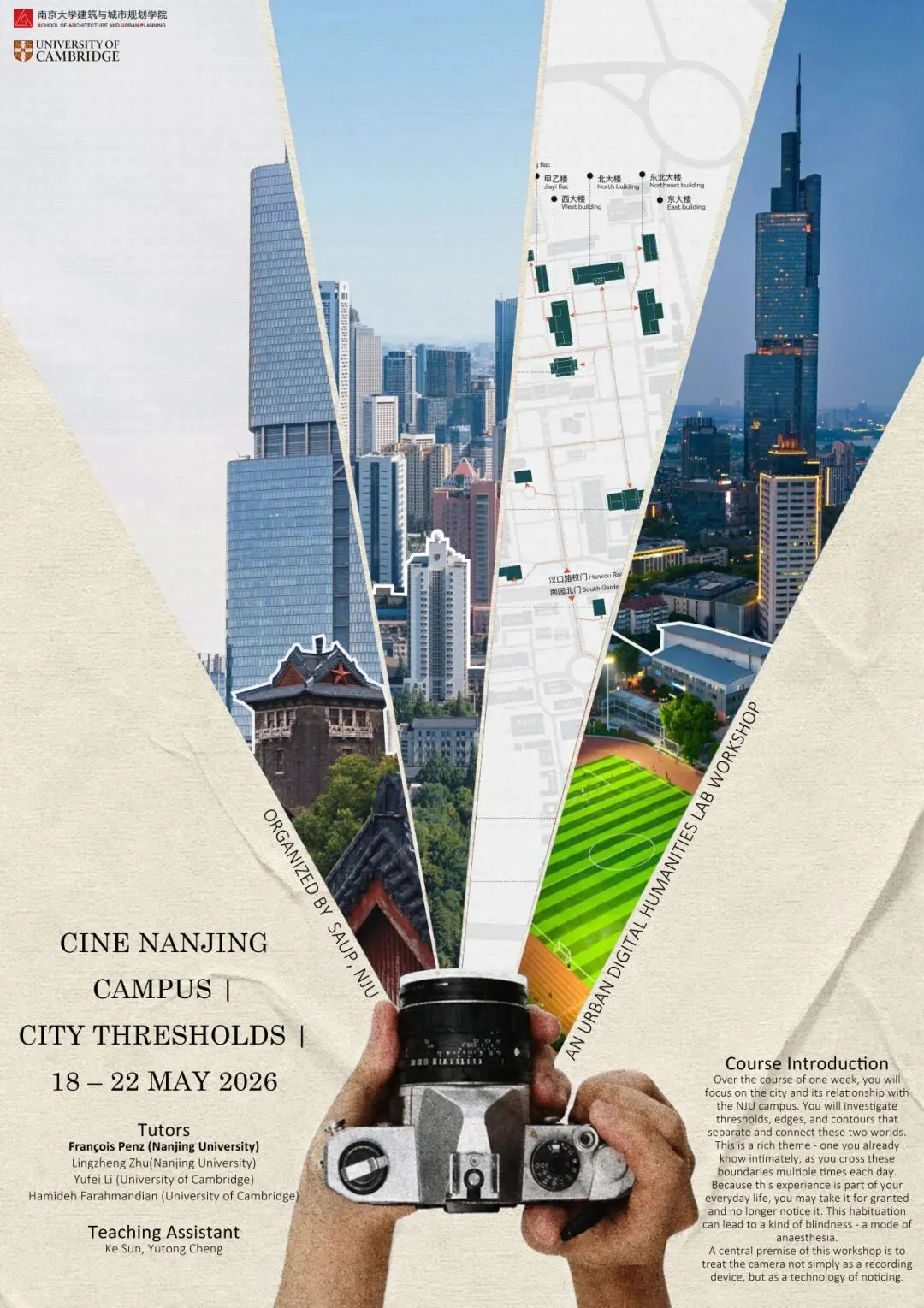
在为期一周的影像建筑学工作坊中,我们将聚焦南京这座城市与南大校园的关系,去观察那些既分隔又连接这两个世界的边界、边缘与轮廓。这是一个极为丰富的主题,对我们而言其实再熟悉不过,每天都要在这些边界上来回穿行许多次。但也正因为这种体验已经变成了日常,我们很可能早已习以为常,不再留意。这种习惯会带来某种“失明”,或者说一种感知上的迟钝。
Over the course of one week, you will focus on the city and its relationship with the NJU campus. You will investigate thresholds, edges, and contours that separate and connect these two worlds. This is a rich theme - one you already know intimately, as you cross these boundaries multiple times each day. Because this experience is part of your everyday life, you may take it for granted and no longer notice it. This habituation can lead to a kind of blindness - a mode of anaesthesia.
本次工作坊的核心出发点是:不把摄影机仅仅当作记录工具,而是看作一种“观察的技术”。摄影机成了一个提问的媒介,帮我们去追问,什么被看见了,什么被忽略了,意义又是如何透过我们的注意力被一点一点建构起来的。因此,请大家有意识地、带着批判性去使用摄影机,不是去记录全部,而是去选择目光落向哪里,把什么纳入画面,又把什么排除在外。经由这个过程,你们会渐渐辨认出那些每天穿行的空间里潜藏的模式、重复与差异,并由此生长出一种对周遭环境更专注、也更具反思性的介入方式。
A central premise of this workshop is to treat the camera not simply as a recording device, but as a technology of noticing. The camera becomes a tool to question what is visible, what is ignored, and how meaning is constructed through attention. You are therefore asked to use the camera deliberately and critically: not to document everything, but to make choices about where to look, what to include, and what to exclude. Through this process, you will begin to recognise patterns, repetitions, and differences in the spaces you traverse daily, developing a more attentive and critical engagement with your surroundings.
研究人在城市空间中的行为,通常并不写在建筑师的设计任务书里,但它却是一项至关重要的能力。透过摄影机观察城市,观看的重心就会转向人们如何居住、如何使用空间。这能让建筑师与城市学者理解,空间在实践中究竟是怎样被激活的。系统地去注视城市中人的移动与互动,这种工作本身就可以被理解为一种空间民族志的方法。它也会带来一种至关重要的分析能力。正如芝加哥社会学派(帕克与伯吉斯)所言:“要改造城市,我们必须首先观察它。” 本次工作坊将引导研究生接触动态影像,把它作为推敲和思考城市场景的一种工具。
Studying how people behave in urban spaces is not usually part of an architect’s brief, yet it is an essential skill. Observing the city through the camera shifts the emphasis toward how people inhabit and use space. It allows architects and urbanists to understand how spaces are activated in practice. Systematically attending to human movement and interaction in the city can be understood as a form of spatial ethnography. This approach will equip you with key analytical abilities. As argued by the Chicago School of Sociology (Park and Burgess), ‘in order to transform the city, we must first observe it.’. This workshop will introduce you to the moving image as a tool for reasoning and thinking through urban scenarios.
导师简介
TUTORS BIOS
弗朗索瓦·彭茨
剑桥大学建筑系荣休教授,自2026年起任南京大学长江学者国际讲席教授,主持正在筹备的城市数字人文实验室。
个人主页:https://arch.nju.edu.cn/szdw/js/20260312/i369293.html
François Penz
He is an Emeritus Professor in the Department of Architecture at the University of Cambridge and, since 2026, a Yangtze River Scholar at NJU, where he directs the newly established Urban Digital Humanities Lab.
Profile link:
https://arch.nju.edu.cn/szdw/js/20260312/i369293.html
朱凌峥
南京大学博士后研究员,剑桥大学建筑学博士。研究方向包括当代数字空间与具身文化遗产、城市视觉民族志、城市环境的文化数据库建模。
Lingzheng Zhu
He is a postdoctoral researcher at Nanjing University and holds a PhD in Architecture from the University of Cambridge. His research interests include contemporary digital spaces and embodied cultural heritage, urban visual ethnography, and the cultural database modelling of urban environments.
李雨霏
英国注册建筑师,英国皇家建筑师学会特许会员(ARB, RIBA Chartered),先后于建筑联盟学院与剑桥大学取得硕士与博士学位。博士研究聚焦殖民历史、视觉文化与场所营造,尤以东亚早期现代主义与文化表达为重心。她将电影制图发展为一种研究方法,将活动影像转化为分析场所与城市感知的空间素材。研究之外,她在伦敦从事建筑实践,专攻文化类历史空间的保护与更新。
Yufei Li
She is a UK-registered architect (ARB, RIBA Chartered). She was educated at the Architectural Association and the University of Cambridge (MPhil, PhD). Her doctoral research engages with colonial histories, visual culture, and placemaking, with a particular focus on early modernism and cultural representation in East Asia. She develops cinematic mapping as a method that transforms moving images into spatial evidence for analysing place and urban perception. Alongside her academic work, she practises architecture in London, specialising in the renovation of heritage cultural venues.
哈米德·法拉赫曼迪安
城市研究者,现于剑桥大学建筑系攻读博士学位并参与教学工作。研究聚焦电影与城市的交汇,以电影作为研究方法与分析视角审视城市生活。她重点关注全球南方城市中的城市非正义、参与式规划与文化表征政治。曾于伊朗科技大学修读城市设计,兼具实践、研究与教学经验。
Hamideh Farahmandian
She is an urbanist and researcher with an MPhil in Architecture and Urban Studies from the University of Cambridge, where she is currently pursuing a PhD and contributing to teaching in the Department of Architecture. Her work explores the intersection of cinema and the city, using film as both method and analytical lens to examine urban life. She focuses on urban injustice, participatory planning, and the cultural politics of representation in cities of the Global South, leading to several publications. She previously studied Urban Design at the Iran University of Science and Technology and has experience across practice, research, and teaching.
学习目标
工作坊结束时,学生应能够:• 运用数字视听媒介,辨识并传达具体城市主题的核心特质;• 理解“电影式空间民族志”的概念与方法内涵;• 建立以电影手段研究日常生活的自觉意识;• 掌握连续性剪辑与蒙太奇的基本技法;• 完成一部承袭城市交响曲传统的短片作品。
Learning Objectives
By the end of the week, you will be expected to:
• Identify and express, through digital audio-visual media, key qualities of specific urban themes.
• Understand the concept of cinematic spatial ethnography.
• Develop an awareness of how film can be used to study everyday life.
• Acquire a basic knowledge of continuity editing and montage.
• Produce a short film in the tradition of the city symphony.
 10个月宝宝每天需要喝多少奶粉?

