光明乳业研究院和南京财经大学汤晓智教授、冯潇副教授团队FH发文:藜麦蛋白颗粒和纤维聚集体在高内相乳液中的界面和连续相稳定机制
- 2026-09-24 12:06:25
(请点击图片查看)
藜麦蛋白颗粒和纤维聚集体在高内相乳液中的界面和连续相稳定机制
近期,光明乳业研究院张弛与南京财经大学汤晓智教授、冯潇副教授团队合作在国际食品TOP期刊Food Hydrocolloids (Q1, IF=12.4)发表题目为“Interfacial and bulk stabilization mechanisms of particulate and fibrillar quinoa protein aggregates in high internal phase emulsions”的研究性论文。
成果亮点
1.热诱导聚集提高了藜麦蛋白初始界面吸附速率,但削弱其降低平衡界面张力的能力
2.颗粒聚集和纤维聚集均降低了藜麦蛋白层的界面刚度
3.纤维聚集体通过形成连续相网络结构稳定高内相乳液
4.颗粒聚集体无法稳定高内相乳液
研究背景
在健康饮食与可持续食品理念的驱动下,植物基蛋白作为动物蛋白的补充品正快速发展。藜麦蛋白作为优质植物蛋白,含全部人体必需氨基酸,营养均衡,但天然结构致密、表面疏水性低,乳化及稳定性能弱于动物蛋白,限制其在结构化食品中的应用。
热处理可以诱导蛋白质的结构重排,形成颗粒状或纤维状聚集体。现有研究证实热诱导的藜麦蛋白聚集物可以提高乳液的稳定性:热诱导的藜麦蛋白颗粒聚集体可通过减小液滴尺寸、增加表面电荷、形成致密界面层来提高高内相乳液的稳定性;而纤维聚集体具有改善的溶解度和界面活性,并能增强界面蛋白吸附。
然而,将乳液稳定性的提升简单归因于界面性质增强尚缺乏充分证据。现有研究多依赖液滴尺寸、ζ电位、界面蛋白负载等间接指标,难以真实反映蛋白质在界面上的吸附行为与力学特性。因此,本研究旨在阐明藜麦蛋白的颗粒和纤维聚集如何影响乳化性能、乳液稳定性和乳液结构,这对结构化食品系统(如高内相乳液和3D打印材料)的设计至关重要。
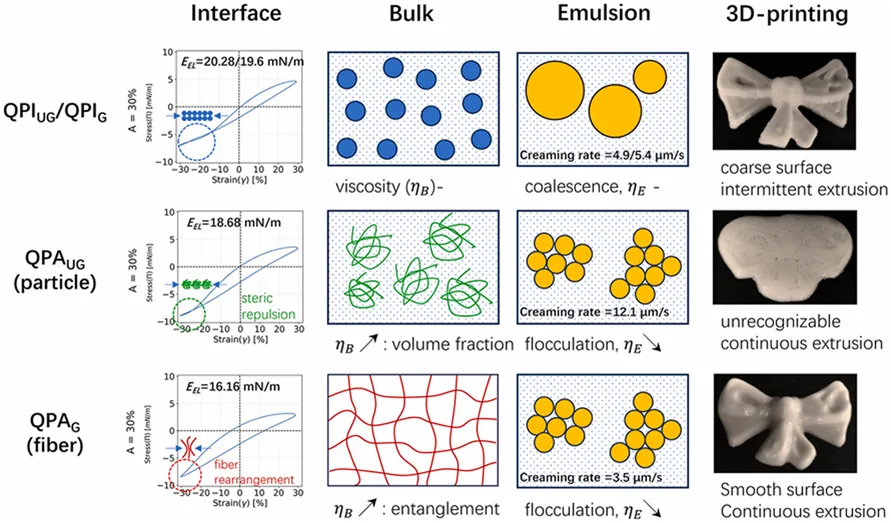
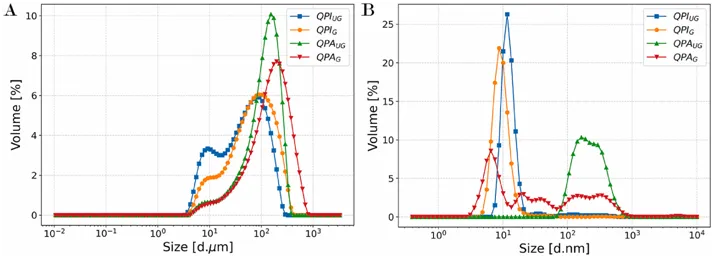
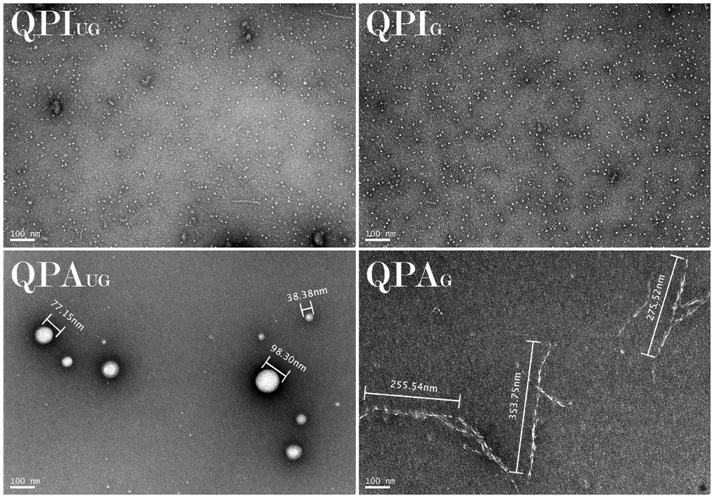
Fig. 3.Transmission electron microscopy (TEM) images of QPAUG(A) and QPAG(B).
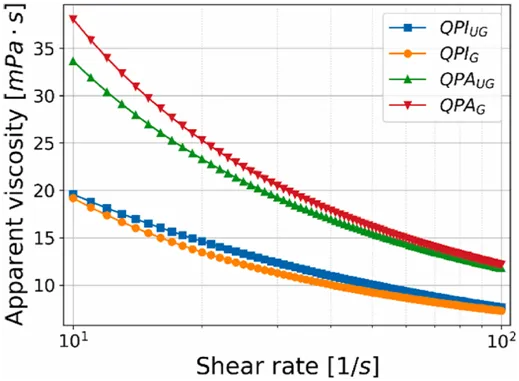
Fig. 4.Viscosity of 3 wt% quinoa protein dispersions (QPIUG, QPIG, QPAUG, QPAG) as a function of shear rate.
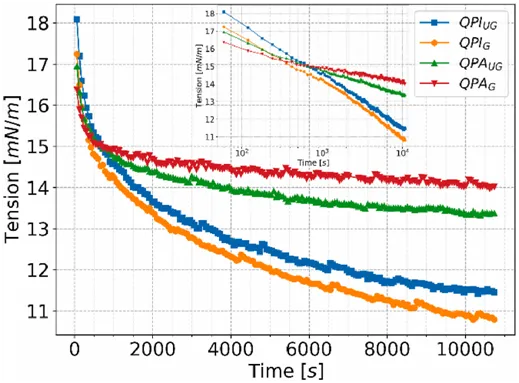
Fig. 5.Dynamic interfacial tension between corn oil and quinoa protein dispersions (QPIUG, QPIG, QPAUG, QPAG). The protein concentrations of quinoa protein supernatants were 0.1 wt%. The inset shows the same data plotted with the x-axis (time) on a logarithmic scale to highlight the early stage of adsorption.
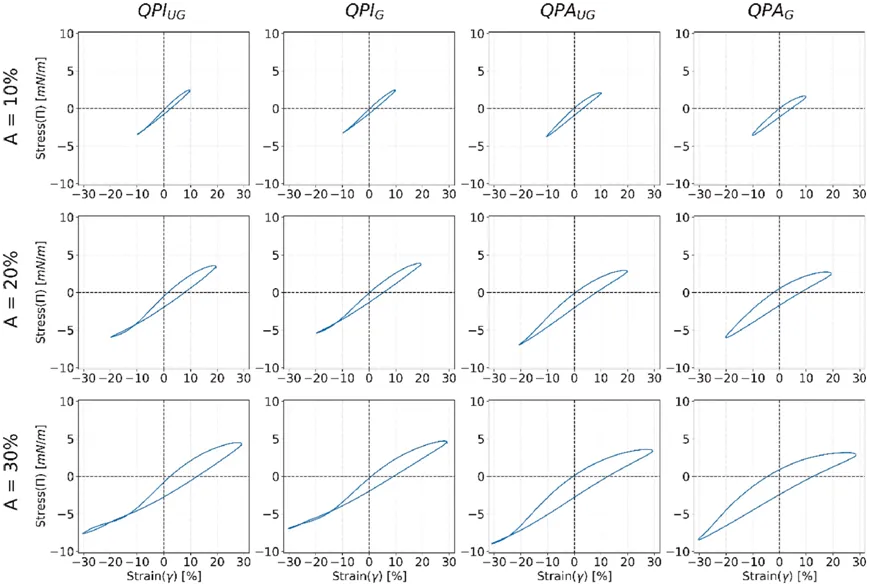
Fig. 6.Lissajous plots of QPIUG, QPIG, QPAUG, and QPAG(from the first column to the fourth column) at amplitudes of 10%, 20% and 30% (from the first row to the third row).
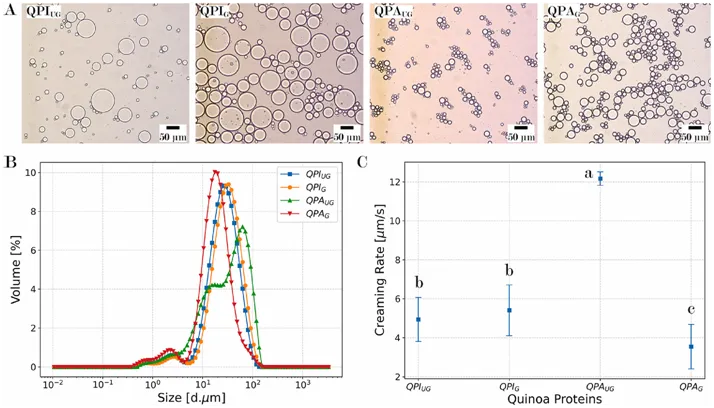
Fig. 7.Optical microscopy images (A), droplet size distribution (B) and creaming rate (C) of emulsion samples (×3 diluted) stabilized with QPIUG, QPIG, QPAUG, and QPAGprotein dispersions at a protein concentration of 3 wt%. Significant differences among different protein samples are denoted as different superscript letters (p < 0.05).
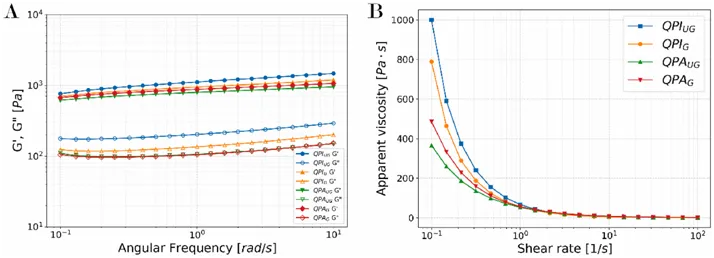
Fig. 8.Frequency dependent elastic (G′) and viscous (G″) moduli (A), and apparent viscosity (B) of emulsions stabilized with QPIUG, QPIG, QPAUG, and QPAGprotein dispersions at a protein concentration of 3 wt%.
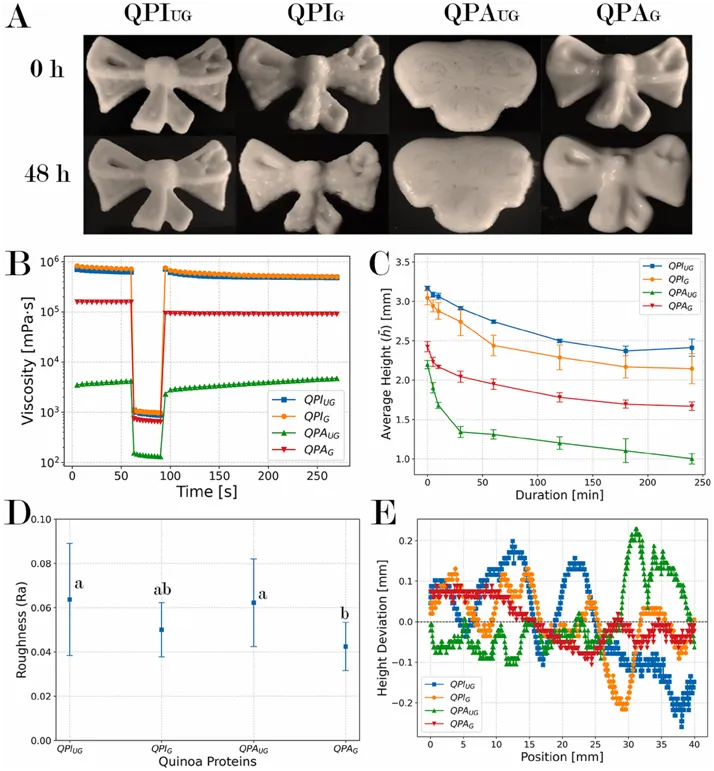
Fig. 9.Appearance of 3D printing model using emulsions stabilized with QPIUG, QPIG, QPAUG, and QPAGprotein dispersions at a protein concentration of 3 wt% (A). Viscosity recovery behavior of the emulsions during the three-interval thixotropy test (B), Average filament height retention (C), surface roughness (D), and height deviation (E) obtained from the single-line printing test. Significant differences among different protein samples in Ra denoted as different superscript letters (p < 0.05).
原文链接



(请点击标题查看)
分子对接与分子动力学黄酮类化合物
食品感官科学与分析农产品贮藏与加工
肉与肉制品蛋与蛋制品水产品
奶及奶制品豆及豆制品果蔬及果蔬制品
大米及米制品
炎症性肠病糖尿病肝病神经疾病
(请点击标题查看)
(请点击学者姓名查看)

在线投稿平台链接:https://www.wjx.top/jq/85151447.aspx
标注‘原创’仅代表原创编译,本平台不主张对原文的版权。本平台转载仅仅是出于学术交流和传播信息的需要,并不意味着代表本平台观点或证实其内容的真实性;转载文章版权归原作者所有,作者如果不希望被转载或有侵权行为,请联系本平台删除。由于编译水平有限,推文或简历有不妥之处,深感抱歉,请联系本平台修改或者删除。
随机文章
-
 10个月宝宝每天需要喝多少奶粉?
- 最新!2026南京中考重要日程安排!
- 乾成南京召开2026年度年中合伙人会议
- 南京招聘|溧水华润万家促销兼职,130元/天
- 深化校地合作 共育法治人才——南京大学法学院与南京市律师协会签署战略合作备忘录
- 南京侨商联合会召开三届三次理事会议
- 六朝烟雨一城金陵●5钻旅居『南京开元大酒店』含2早4正纯玩三日游499元◆自行游玩牛首山&总统府&夫子庙&玄武湖等◆可升级免费棋牌房
- 强强联动,共促转化|南京江北新区药康生物医药转化平台有限公司与全国高校生物医药区域技术转移转化中心(江苏)达成深度合作
- 【南京】初、高多学科招聘,年薪30W+,南京市金陵河西学校教师招聘公告(6月26日截止)
- 抗击新型肺炎疫情,南京江宁文艺在行动
- 江苏省交通物流(快递)行业工作交流会在南京召开

