2026年2月18日,南京农业大学植物保护学院陈法军教授联合中国农科院植物保护研究所江幸福研究员在昆虫学领域著名期刊《Pest Management Science》上发表了一篇题为”Intercropping legumes in the tea agroecosystem modulates tea quality and suppresses insect pest populations”的研究论文(https://doi.org/10.1002/ps.70653),旨在为制定生态韧性高且经济可行的茶树可持续管理和生态控害及其生产实践提供帮助。
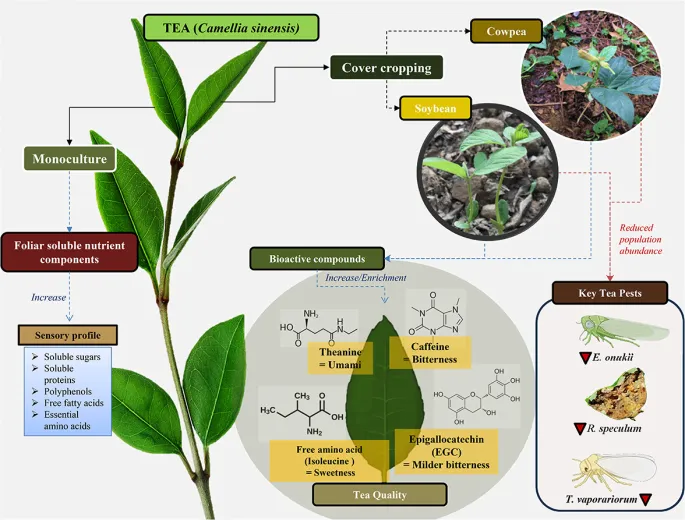
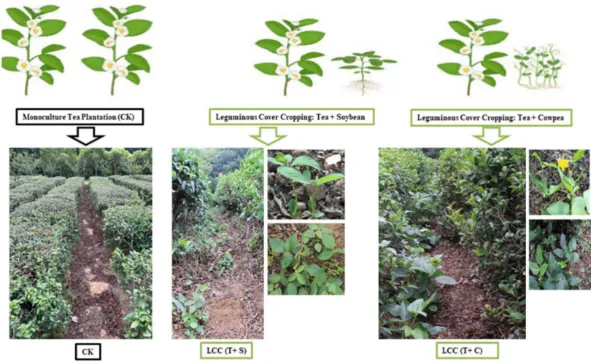
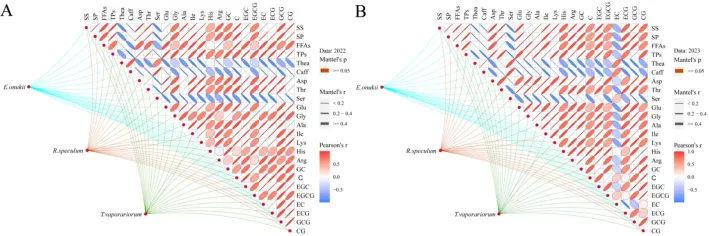
该研究实验地位于江苏省南京市中山陵风景区中山陵茶场(见图1),试验研究了茶园间作豆科绿肥作物(leguminous cover cropping, LCC)—大豆(soybean, S)和豇豆(cowpea, C)对茶叶品质特性及关键茶树害虫种群发生的影响。研究表明,与单一种植(monoculture cropping, MCC)的茶园相比,茶园间作大豆(LCC-S)和豇豆(LCC-C)显著提高了茶树叶片中关键生物活性化合物(如咖啡因、茶氨酸、没食子儿茶素和异亮氨酸等)的浓度。此外,LCC-S和LCC-C还显著降低了三种主要茶树害虫(包括小绿叶蝉Empoasca onukii、广翅蜡蝉Ricania speculum和白粉虱Trialeurodes vaporariorum)的种群数量。进一步对茶园中主要害虫种群数量与茶叶品质参数进行相关分析表明,在两个研究年度中(A-2022;B-2023),三种主要茶树害虫—小叶茶蛾(E. onukii)、广翅蜡蝉(R. speculum)和白粉虱(T. vaporariorum)与茶树叶片可溶性营养成分呈显著负相关,而与咖啡因、茶氨酸及丝氨酸呈正相关(Fig.2)。
Fig.1Field layout model of the leguminous cover cropping (LCC) with soybean (S) and cowpea (C) in tea plantation rows. LCC, leguminous covercropping; LCC-S, LCC with soybean; LCC-C, LCC with cowpea; CK, control as the monoculture cropping (MCC)
Fig.2 Correlation heat map illustrating the population abundances of three major tea insect pests and the foliar concentrations of tea quality parameters in tea plantations in 2022 (A) and 2023 (B). In the correlation heat maps, red color indicates a positive correlation and blue indicates a negative correlation; the intensity of the color represents the degree of correlation.
可见,茶园间作绿肥作物可提升茶叶品质并降低害虫种群发生,进而减少化学杀虫剂的使用,助力茶园生态绿色安全生产。此外,作为已明确的豆科绿肥作物大豆,以及具有气候适应性和吸引有益天敌昆虫的豇豆,为茶园自然控害和可持续茶树种植提供了高效的间作绿肥作物,从而为建立更可持续且经济可行的茶树种植管理奠定了基础。后续研究应着重开展长期田间调查,以更系统地评估研究成果的有效性,并探索这些实践在不同茶树种植区的推广可行性。
南京农业大学为该论文的第一完成单位,尼泊尔籍博士研究生Sabin Saurav Pokharel为第一作者,陈法军教授和江幸福研究员为共同通讯作者。该研究获得国家农业产业技术体系(CARS-22)和国家重点研发计划项目(2023YFD1400800)资助,该论文详见:https://doi.org/10.1002/ps.70653。此外,Sabin Saurav Pokharel博士研究生就读期间还发表了一系列茶园可持续管理和生态控害的研究成果(见研究论文:BMC Plant Biology, 2022, 22: 166; Agronomy, 2025. 15: 2217. 见综述论文:Global Ecology and Conservation, 2021, 27: e01553; Plants, 2023, 12 (12), 2361)。
²相关研究成果:
1.Pokharel SS, Ali Z, Wang CY, Jiang X*, Chen, F*. 2026. Intercropping legumes in the tea agroecosystem modulates tea quality and suppresses insect pest populations. Pest Management Sciencehttps://doi.org/10.1002/ps.70653
2.PokharelSS, Ali Z, Wang CY, Jiang XF, Chen FJ*. 2025. Leguminous cover crops promote microbial community diversity in rhizosphere soil of tea plants. Agronomy, 15: 2217. https://doi.org/10.3390/agronomy15092217
3.Pokharel SS, Yu H, Fang WP, Parajulee MN, Chen, F*. (2023). Intercropping cover crops for a vital ecosystem service: A review of the biocontrol of insect pests in tea agroecosystems. Plants, 12(12), 2361. https://doi.org/10.3390/plants12122361
4.Pokharel SS, Zhong YN, Lv CN, Shen FY, Li LK, Parajulee MN, Fang WP*, Chen FJ*. 2022. Influence of reduced N-fertilizer application on foliar chemicals and functional qualities of tea plants under Toxoptera aurantii infestation. BMC Plant Biology, 22: 166.https://doi.org/10.1186/s12870-022-03533-9
5.Pokharel SS, Shen FY, Parajulee MN, Wang YH, Chen FJ*. (2021). Effects of elevated atmospheric CO2 concentration on tea quality and insect pests’ occurrences: A review. Global Ecology and Conservation, 27: e01553. https://doi.org/10.1016/j.gecco.2021.e01553

 10个月宝宝每天需要喝多少奶粉?

