南京工业大学罗宏斌/加州州立大学Liu Yangyang/南开大学张振杰合作Angew: 两性离子“赋能”乙烯基COF,构建高性能质子电解质
- 2026-10-12 17:15:48

第一作者:李浩宇、张国芹
通讯作者:罗宏斌、Yangyang Liu、张振杰
通讯单位:南京工业大学、加州州立大学洛杉矶分校、南开大学

近日,南京工业大学罗宏斌、加州州立大学Liu Yangyang、南开大学张振杰教授团队合作,在固态质子电解质领域取得重大突破,研究成果发表在国际顶级期刊《Angewandte Chemie International Edition》上。通过在磺基甜菜碱两性离子乙烯基连接共价有机框架(ZVCOF)孔道中负载磷酸(PA),研究团队制备获得了复合固态质子电解质PA@ZVCOF。该电解质在常温下的质子传导率高达5.34 × 10⁻² S cm-1,创造了COF基质子电解质在常温下的新纪录。同时,其高温质子传导率(1.79 × 10⁻¹ S cm-1)也处于目前最先进水平。基于此电解质组装的固态质子电池,展现出108.5 mAh g-1的高比容量(1.0 A g-1电流密度)和卓越的长循环稳定性(循环2000次后容量保持率高达90%),两项关键性能指标均刷新了固态质子电池的记录。尤为重要的是,该固态电解质有效解决了传统液态酸电解质腐蚀电极的难题,为开发高安全、长寿命的下一代储能器件提供了全新方案。

随着对能源安全和能量密度的要求日益提高,开发高性能、高安全性的下一代电池技术成为科研界和产业界的焦点。质子电池因其电荷载体质子(H+)具有最小的离子半径、最低的原子质量和丰富的自然资源,展现出优异的倍率性能和成本优势,被视为极具潜力的新型储能系统。然而,质子电池中传统酸性电解液面临易泄露、电化学窗口窄、对电极材料溶解以及电池组件腐蚀等挑战。因此,开发高性能的固态质子电解质是推动质子电池走向实用的关键。在众多固态电解质材料中,COFs因其结构可调、孔道规整、化学稳定性好等优点,成为理想的候选平台。但现今COF基质子导体大多需要在高温或高湿环境下才能实现高质子传导率,在室温无外加湿度下的性能普遍不佳,这极大地限制了其在质子电池中的应用。

针对上述挑战,研究团队独辟蹊径,提出了一种“两性离子工程”设计策略,在COF骨架中引入兼具正负电荷基团的两性离子官能团,旨在协同解决质子解离与质子迁移这两个关键科学问题。引入的两性离子官能团在COF骨架中形成一个个“微型质子泵”,有效促进了质子的解离与迁移过程。实验结果表明,基于两性离子COF的复合电解质在室温下的质子传导率高达5.34 × 10⁻² S cm-1,成功突破了COF基质子导体在室温无外加湿度条件下的性能瓶颈,展现出与商业Nafion膜相当甚至更优的传导性能。此外,将该电解质应用于固态质子电池中,不仅实现了创纪录的比容量和优异的循环稳定性,还直观证明了固态电解质对电极的有效保护作用,为替代传统液态酸电解质提供了有力支撑。

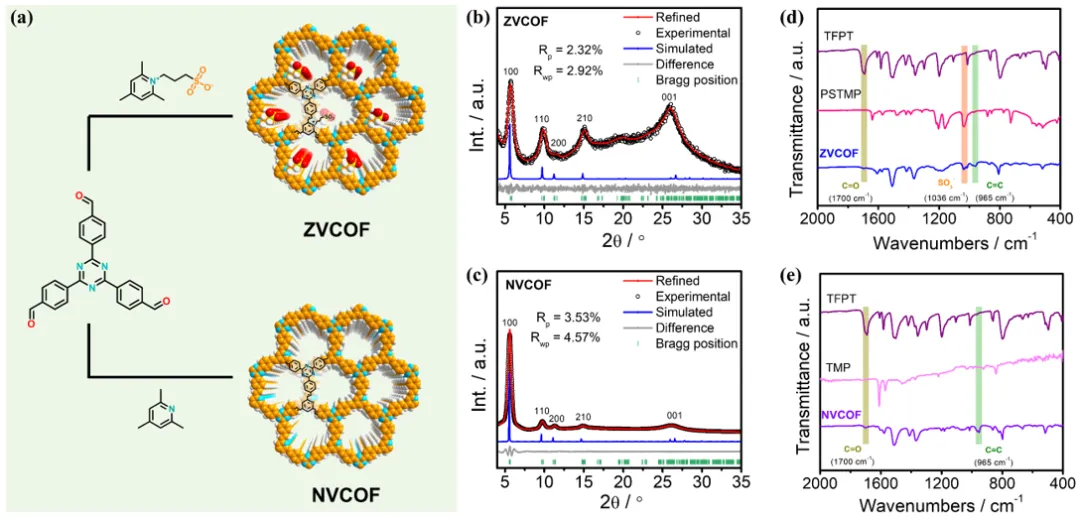
Figure 1. (a) Schematic syntheses and (b, c) Pawley refinement of PXRD patterns for ZVCOF and NVCOF. (d, e) FT-IR spectra of ZVCOF, NVCOF, and corresponding monomers.
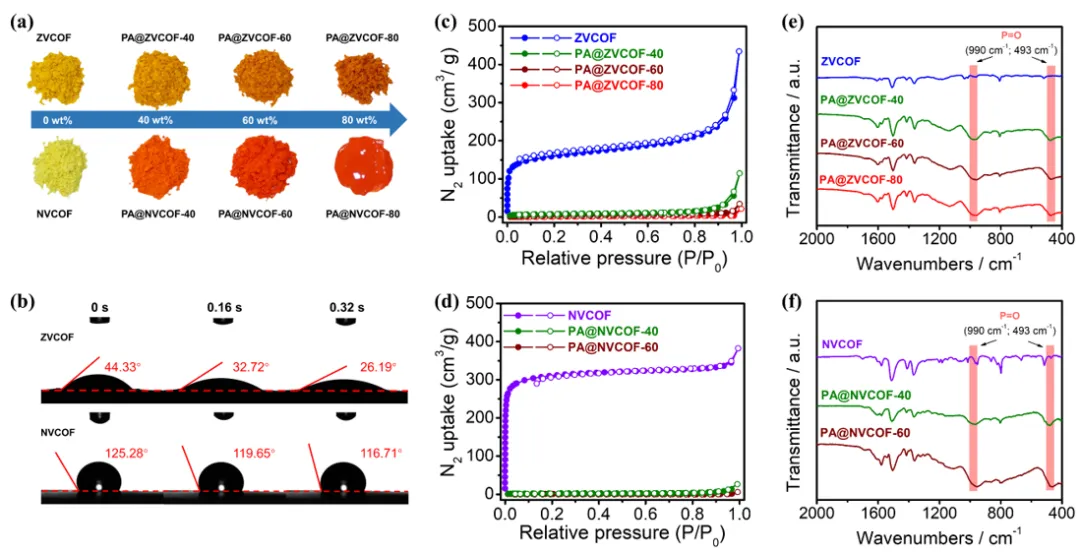
Figure 2. (a) Optical images of ZVCOF, NVCOF, and the corresponding composites with different PA loading. (b) Time-dependent contact angles of PA on the surfaces of ZVCOF and NVCOF pellets. (c, d) N2 adsorption-desorption isotherms at 77 K and (e, f) FT-IR spectra of ZVCOF, NVCOF, and the corresponding composites with different PA loading.
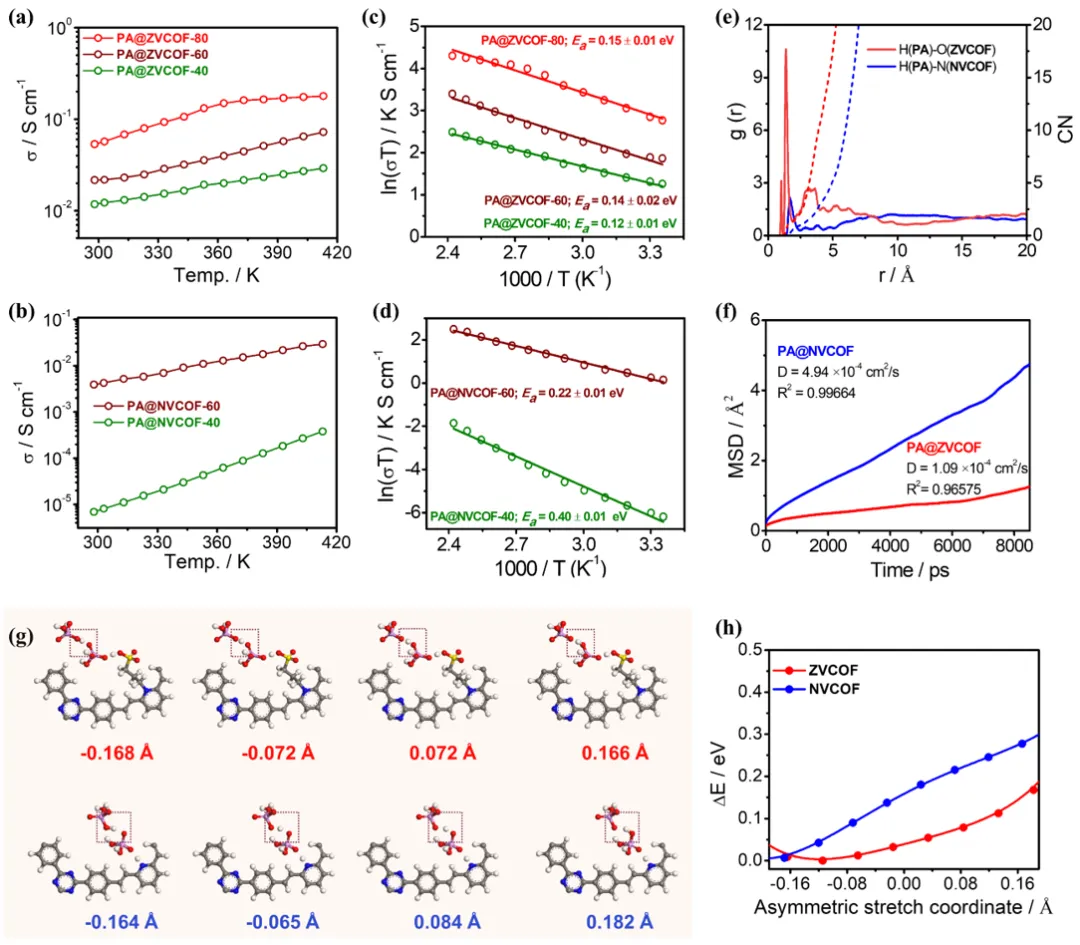
Figure 3. (a, b) Temperature-dependent proton conductivity and (c, d) Arrhenius plots of the proton conductivities of PA@ZVCOF-X (X = 40–80) and PA@NVCOF-X (X = 40–60). (e) Radial distribution functions (RDF) of H(PA)-O(ZVCOF) and H(PA)-O(NVCOF), along with the coordination numbers (CN). (f) Calculated mean square displacement (MSD) of PA molecules as a function of the simulation time. (g) Simulated snapshots illustrating the proton dissociation process of a representative PA molecule within the ZVCOF and NVCOF frameworks, along with (h) the corresponding relative energy profiles.
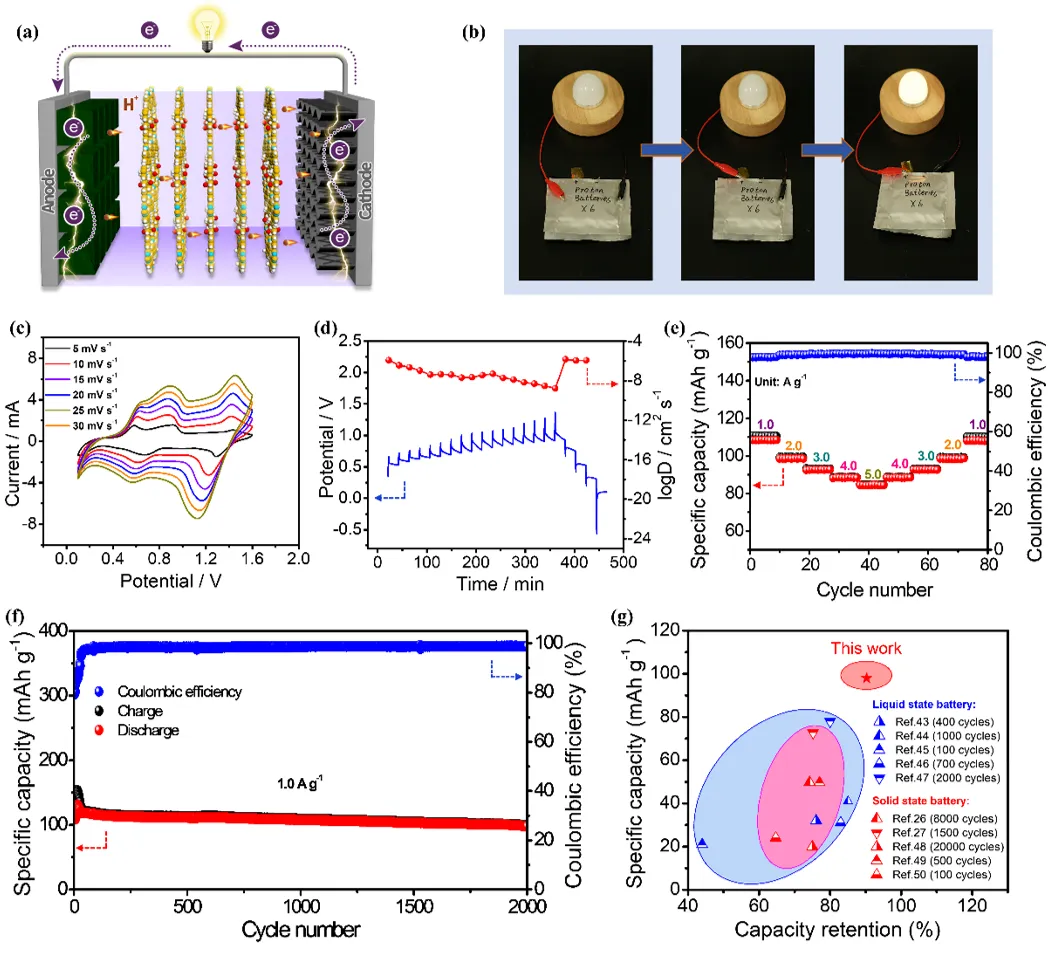
Figure 4. (a) Schematic representation of a solid-state proton battery using PA@ZVCOF-80 electrolyte. (b) Photographs of an LED bulb lighted up by the solid-state proton battery. (c) CV curves at different scan rates, (d) GITT curve and corresponding proton diffusion coefficient of the solid-state proton battery. (e) Rate performance of the solid-state proton battery. (f) Cycling stability and Coulombic efficiency of the solid-state proton battery at a current density of 1.0 A g-1. (g) Comparison of specific capacity and capacity retention of the solid-state proton battery using PA@ZVCOF-80 electrolyte with other reported proton batteries.
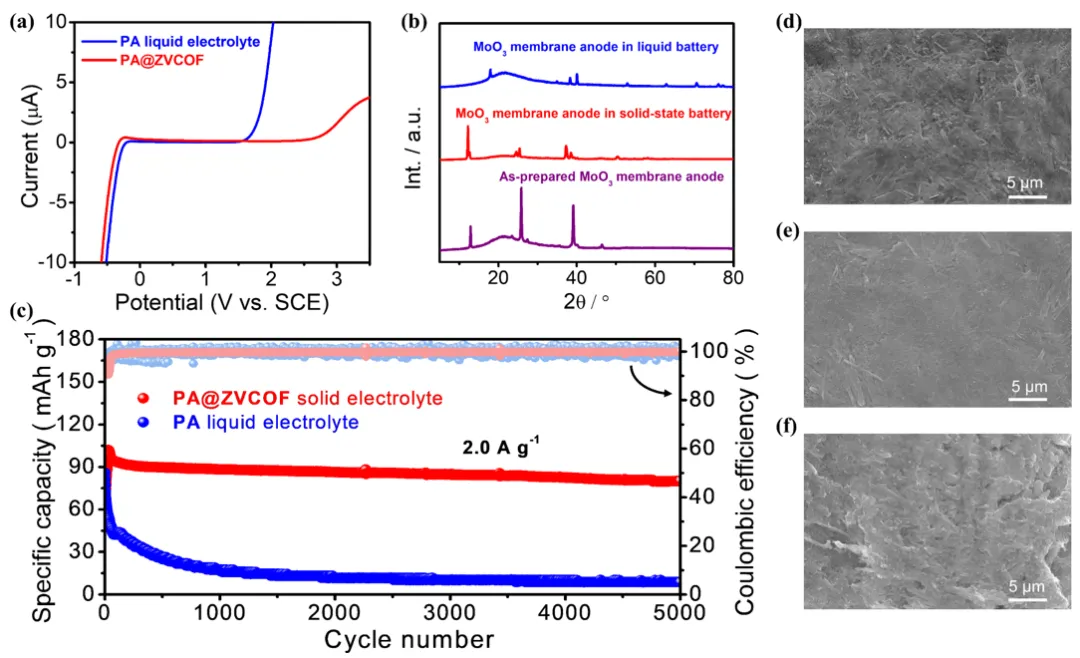
Figure 5. (a) Linear scanning voltammetry curves of PA@ZVCOF-80 and a PA aqueous electrolyte (5.0 M). (b) XRD patterns of the as-prepared MoO3 membrane anode (purple), the MoO3 membrane anode after cycling tests in a solid-state proton battery (red) and in a proton battery with PA aqueous electrolyte (5.0 M; blue). (c) Cycling performance of proton batteries using PA@ZVCOF-80 or a PA aqueous electrolyte at the current density of 2.0 A g-1. SEM images of (d) as-prepared MoO3 membrane anode, the MoO3membrane anode after cycling tests in (e) solid-state proton battery and (f) proton battery with PA aqueous electrolyte.

Hao-Yu Li, Guo-Qin Zhang, Hong-Bin Luo,* Jin Zhang, Dong-Sheng Shao, Qiao Qiao, Fengdong Wang, Yangyang Liu,* Zhenjie Zhang,* Xiao-Ming Ren, Zwitterionic Engineering of Vinylene-Linked Covalent Organic Frameworks for Superior Protonic Electrolytes. Angew. Chem. Int. Ed. 2026, e7677012. doi.org/10.1002/anie.7677012.
版权声明
测试表征+计算+绘图

随机文章
-
 10个月宝宝每天需要喝多少奶粉?
- 【南京治疗狐臭排名靠前的医院】孩子腋下有异味怎么消除
- 重大损失!他在南京离世
- 南京江北新区小红花幼儿园幼儿一周食谱
- 南京高价回收2014年茅台酒五粮液拉菲上门估价成交快手续简单当天结款不拖延【免费鉴定】专业评估出价合理快捷上门立即交易
- 南京路上的中华老字号——上海蔡同德堂
- 【南京3200元】入住48人,太美系统.无烟检
- 护士30人!南京医科大学附属明基医院,招满即止
- 南京回收茅台五粮液拉菲上门估价—回收老酒找我们专业评估当面出价当天成交免费评估到家验货当面付款即刻上门安排欢迎联系
- 南京回收茅台~飞天+整箱※上门回收各类名酒,专业回收陈年老酒、威士忌、洋酒,高价回收,全城可上门
- 春日来信 致我最爱的“她”—南京市光华东街幼儿园小一班三八妇女节活动

