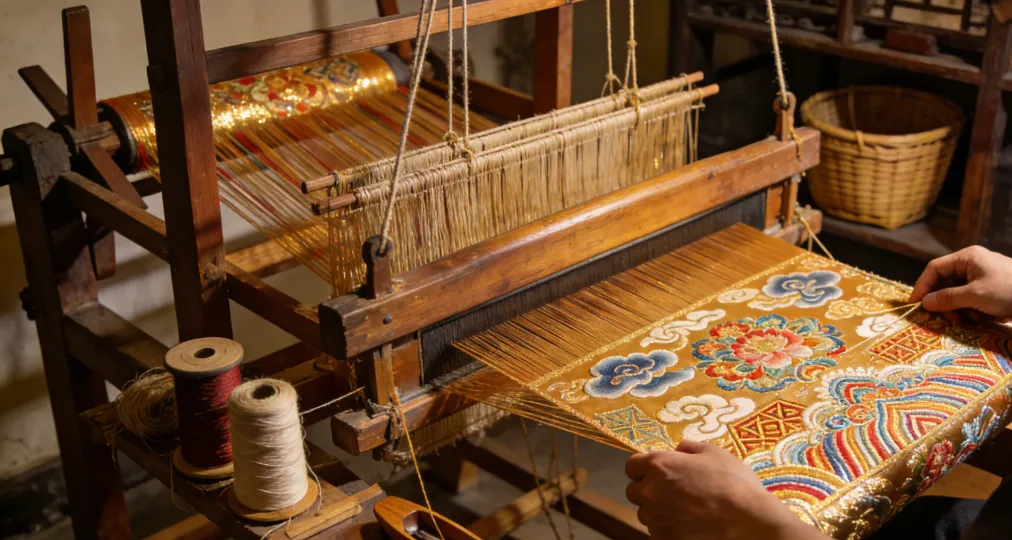
Its complete production process is extremely complex and meticulous. First, raw materials such as mulberry silk need to undergo dyeing and processing, and specially made gold and silver threads as well as peacock feathers need to be prepared. Then, the artisans follow the principles of "beauty, spaciousness, and grandeur" to design the patterns, drawing detailed designs that can be precisely executed down to each individual thread. The core process of "weaving patterns" uses the ancient principle of knotting to transform the design into a programmed "pattern base" made of silk threads. When weaving on a large loom, complex assembly procedures need to be completed on the wooden loom. The weaver on top raises the warp threads according to the pattern, while the weaver below cooperates by inserting shuttles, introducing gold threads with chisel-shaped tools, passing through pipes to carve the patterns (i.e., "passing the warp thread and cutting the weft thread") and weaving the weft. The two work together, and each day they can only weave a few inches. This series of rigorous procedures collectively constitute the exquisite craftsmanship system of Yunzhuang as an ancient royal imperial fabric.



 10个月宝宝每天需要喝多少奶粉?

