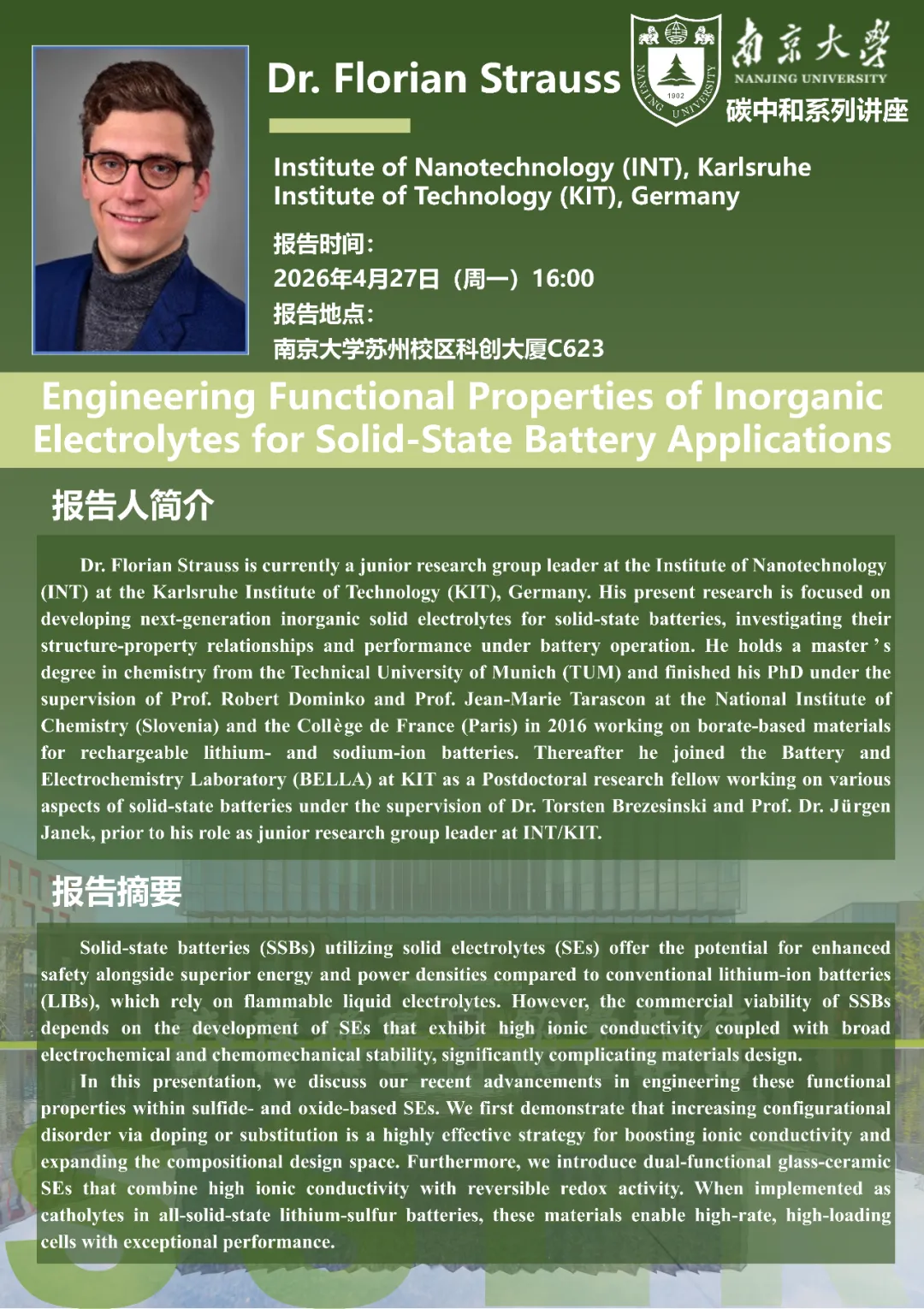
Solid-state batteries (SSBs) utilizing solid electrolytes (SEs) offer the potential for enhanced safety alongside superior energy and power densities compared to conventional lithium-ion batteries (LIBs), which rely on flammable liquid electrolytes. However, the commercial viability of SSBs depends on the development of SEs that exhibit high ionic conductivity coupled with broad electrochemical and chemomechanical stability, significantly complicating materials design.
In this presentation, we discuss our recent advancements in engineering these functional properties within sulfide- and oxide-based SEs. We first demonstrate that increasing configurational disorder via doping or substitution is a highly effective strategy for boosting ionic conductivity and expanding the compositional design space. Furthermore, we introduce dual-functional glass-ceramic SEs that combine high ionic conductivity with reversible redox activity. When implemented as catholytes in all-solid-state lithium-sulfur batteries, these materials enable high-rate, high-loading cells with exceptional performance.

 10个月宝宝每天需要喝多少奶粉?

