燕山大学赵阳&南京大学赵伟伟‖【Anal. Chem.】自供电有机光电电化学晶体管用于恩诺沙星检测
- 2026-09-26 06:04:40
点击蓝字

关注我们
介绍 /Introduction
研究图文/Introduction
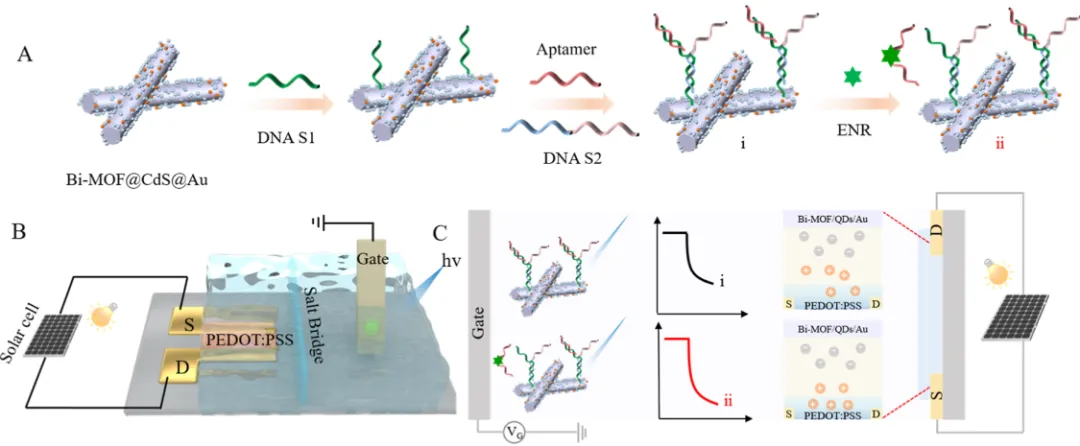
Figure 1. (A) Schematic of the ENR detection. (B) The H-cell-supported self-powered OPECT system. (C) Operation rationale of the selfpowered OPECT system.

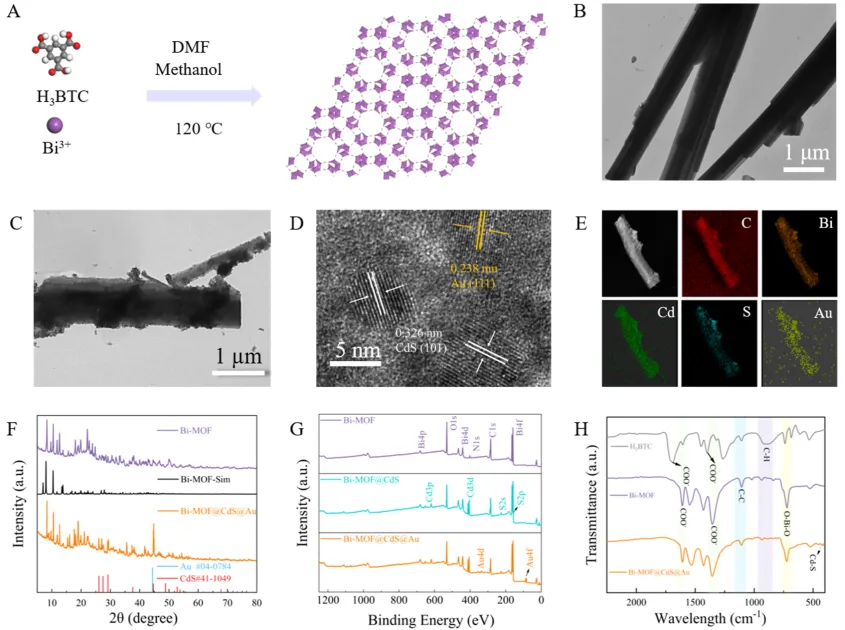
Figure 2. (A) Synthetic process of Bi-MOF. TEM images of Bi-MOF (B) and Bi-MOF@CdS@Au (C). (D) HRTEM image and EDS mapping (E) of Bi-MOF@CdS@Au. (F) XRD spectra of Bi-MOF and Bi-MOF@CdS@Au. (G) XPS spectra of Bi-MOF, Bi-MOF@CdS, and Bi-MOF@CdS@ Au. (H) FTIR spectra of H3BTC, Bi-MOF, and Bi-MOF@CdS@Au.

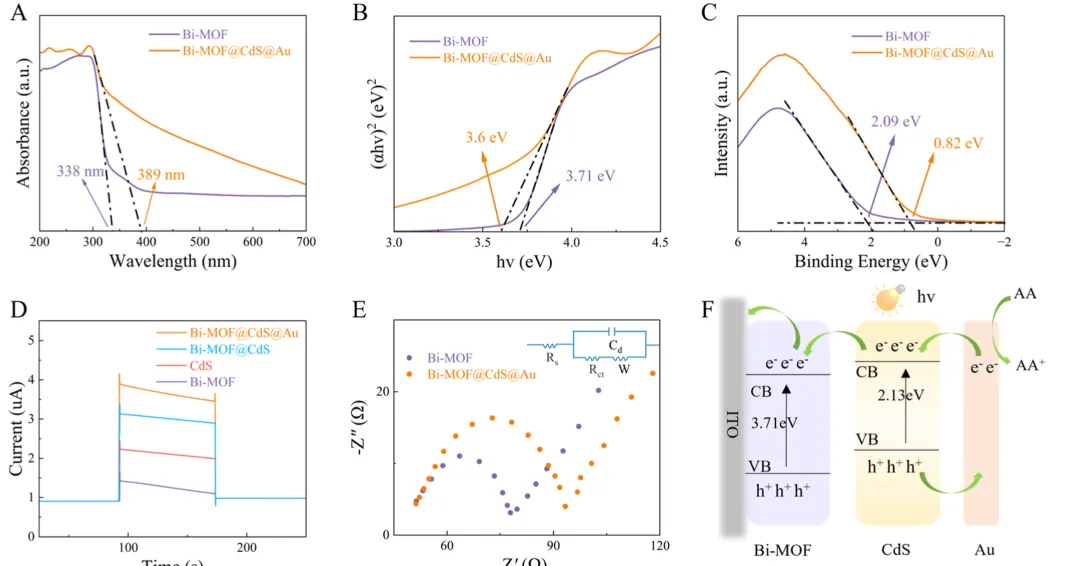
Figure 3. (A) UV-vis absorption spectra, (B) Tauc plots and VB-XPS, and (C) survey spectra of Bi-MOF and Bi-MOF@CdS@Au. (D) Photoelectric signal response of Bi-MOF, CdS, Bi-MOF@CdS, and Bi-MOF@CdS@Au. (E) EIS Nyquist plots of Bi-MOF and Bi-MOF@CdS@Au. (F) Photoelectric charge transfer mechanism of Bi-MOF@CdS@Au.

结论 /Conclusion
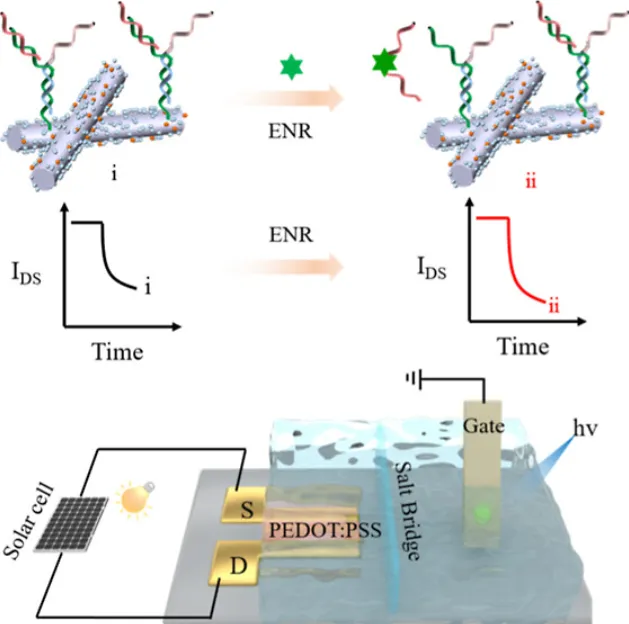
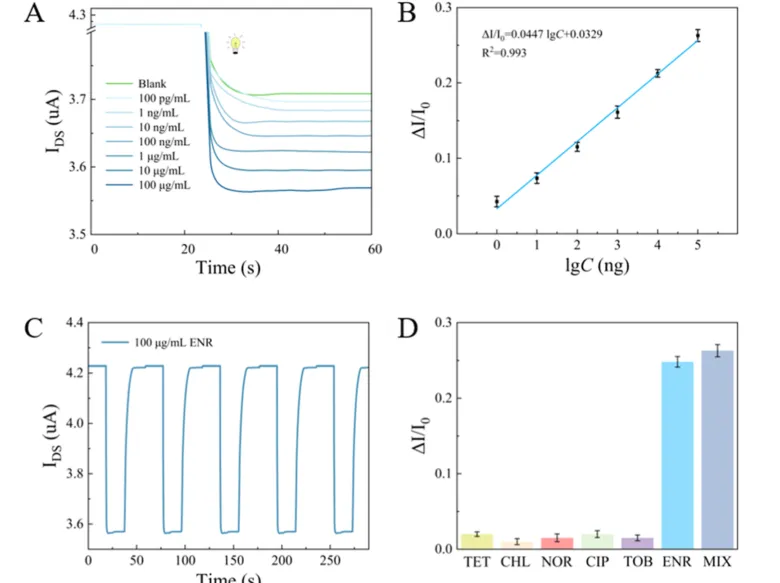
总之,我们开发了一种自供电的 OPECT 系统,该系统克服了传统 OPECT 设备中固有的双电压限制。BiMOF@CdS@Au 三元异质结构的合理设计有效地解决了电荷复合问题,同时促进了光能吸收,从而显著提高了分析性能。在栅极界面处的 ENR-适配体识别导致了敏感的栅极电位调制,通过 OPECT 的高导通电阻放大了这一效应,产生了可测量的 IDS 响应,用于超灵敏检测,最低检测水平可达 0.568 pg/mL。这种自供电的 OPECT 有效地缓解了双电压驱动系统所存在的限制,有望成为先进生物电子检测的通用解决方案。
文献信息 /Literature information
Self-Powered Organic Photoelectrochemical Transistor DetectionChunwang Chai, Yang Zhao,* Hanxiao He, Yuan-Cheng Zhu, Yazhou Wang, Hui-Min Jia, and Wei-Wei Zhao*原文链接:https://doi.org/10.1021/acs.analchem.5c06716
点击左下角“阅读原文”,轻松获取原文信息

扫描上侧二维码
关注我们
免责声明
「原创」仅代表原创编译,水平有限,仅供学术交流,本平台不主张原文的版权,如有侵权,请联系删除。文献解读或作者简历如有疏漏之处,我们深表歉意,请作者团队及时联系chemsensing@163.com,我们会在第一时间进行修改或撤稿重发,感谢您的谅解!

END


投稿、荐稿、合作请联系邮箱
chemsensing@163.com





随机文章
-
 10个月宝宝每天需要喝多少奶粉?
- 南京医科大学2026年法学硕士复试线说明
- 2025专业分数线|南京农业大学
- 南京贷款公司有哪些?南京市贷款怎么办理?在江苏南京贷款到哪里办?
- 南京邮资机宣传戳(TS71型)图录(2022-2025)
- 湖南铁道职业技术大学真来了!赶在南京铁道前升本,广铁南铁武铁压力更大
- 火遍全网的加拿大博主,是南京十三中老师!
- (事业编制)南京大学机器人与自动化学院2026年度准聘长聘岗位招聘公告
- 十天后南京这条无人樱花大道不许你错过
- 我说我是南京信息工程大学毕业的,面试官都惊呆了...
- 谁懂啊!在南京近郊藏着一座600年的明清古村,白墙黛瓦,杨柳湖畔,没有商业化的喧嚣,只有岁月静好

