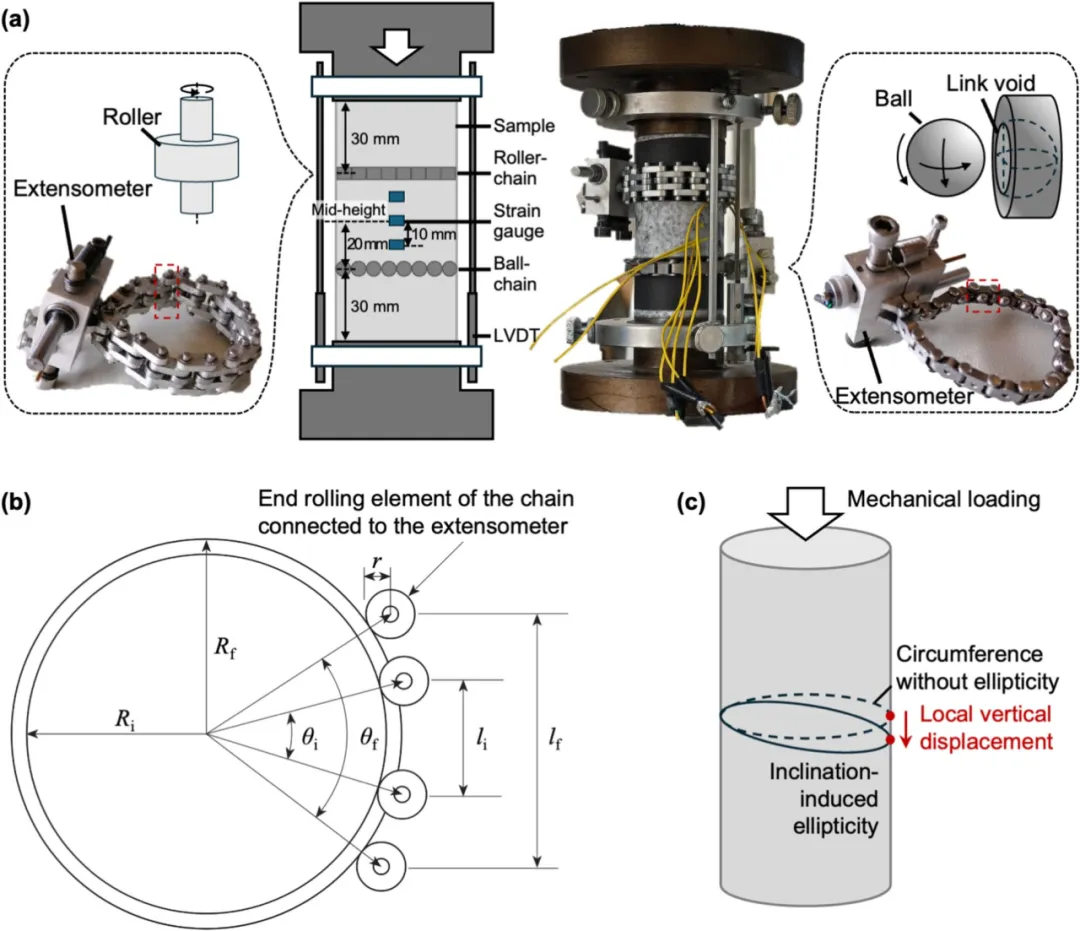
Fig.1 Experimental setup for the uniaxial compression test and detailed views of the chain extensometers, as well as circumferential strain calculation method. a Uniaxial compression test setup (middle) with detailed views of the roller-chain (left) and ball-chain (right) extensometers. The roller rotates around a central axis that connects adjacent links, while the ball is seated in a spherical void allowing free rotation in all directions. Both chain extensometers are mounted simultaneously on the same sample to compare the accuracy of circumferential deformation measurements, with strain gauges serving as a reference. The arrow on the upper loading cap indicates the loading direction. A linear variable differential transformer (LVDT) is used to monitor axial deformation. In separate tests, the positions of the two extensometers are swapped to avoid positional bias. b Under vertical compressive loading, lateral expansion due to the Poisson effect causes a change in chord length captured by the extensometer, while the chain length remains unchanged and the rollers allow lateral expansion (MTS 2004). c Local vertical displacement leads to chain inclination associated with ellipticity. Here, r is the radius of the rolling element of the extensometer chain; Ri and Rf denote the initial and final sample radii, respectively; θi and θf are the angles (in radians) subtended by the initial and final chord lengths (li and lf)
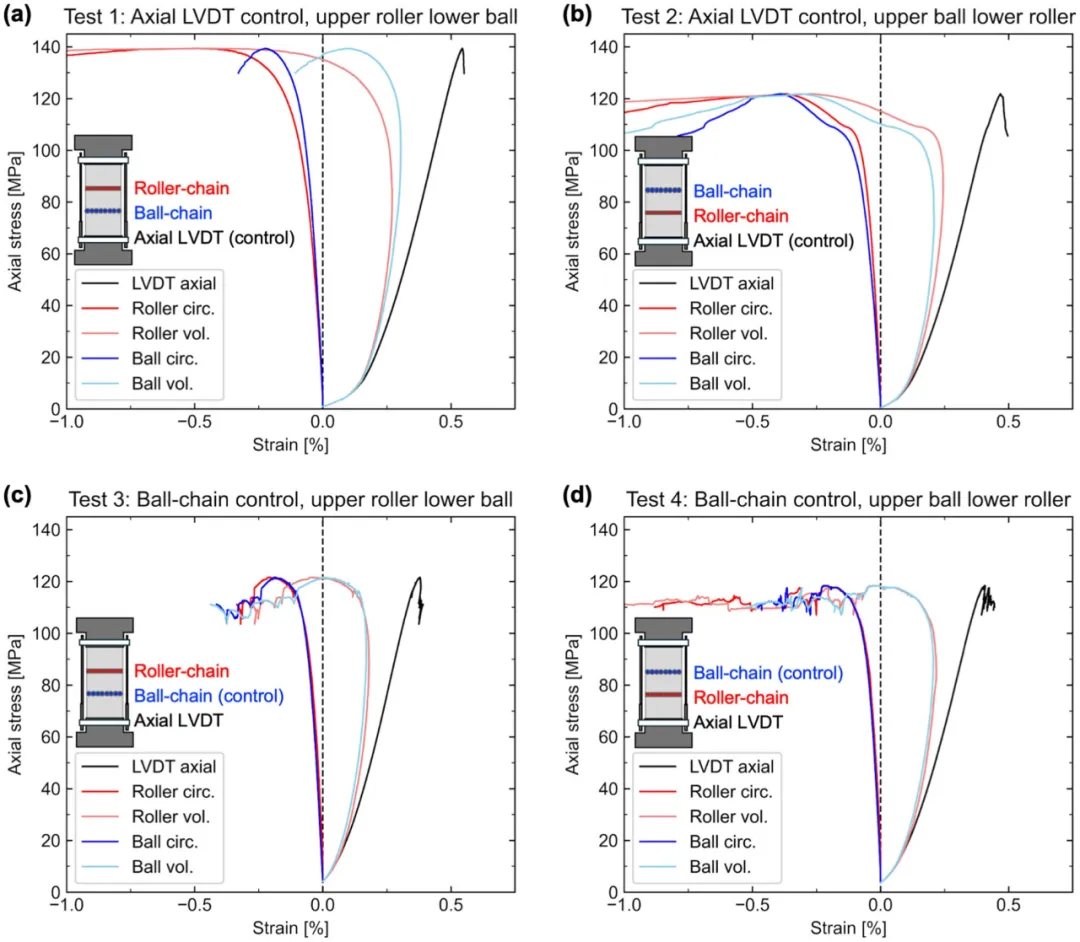
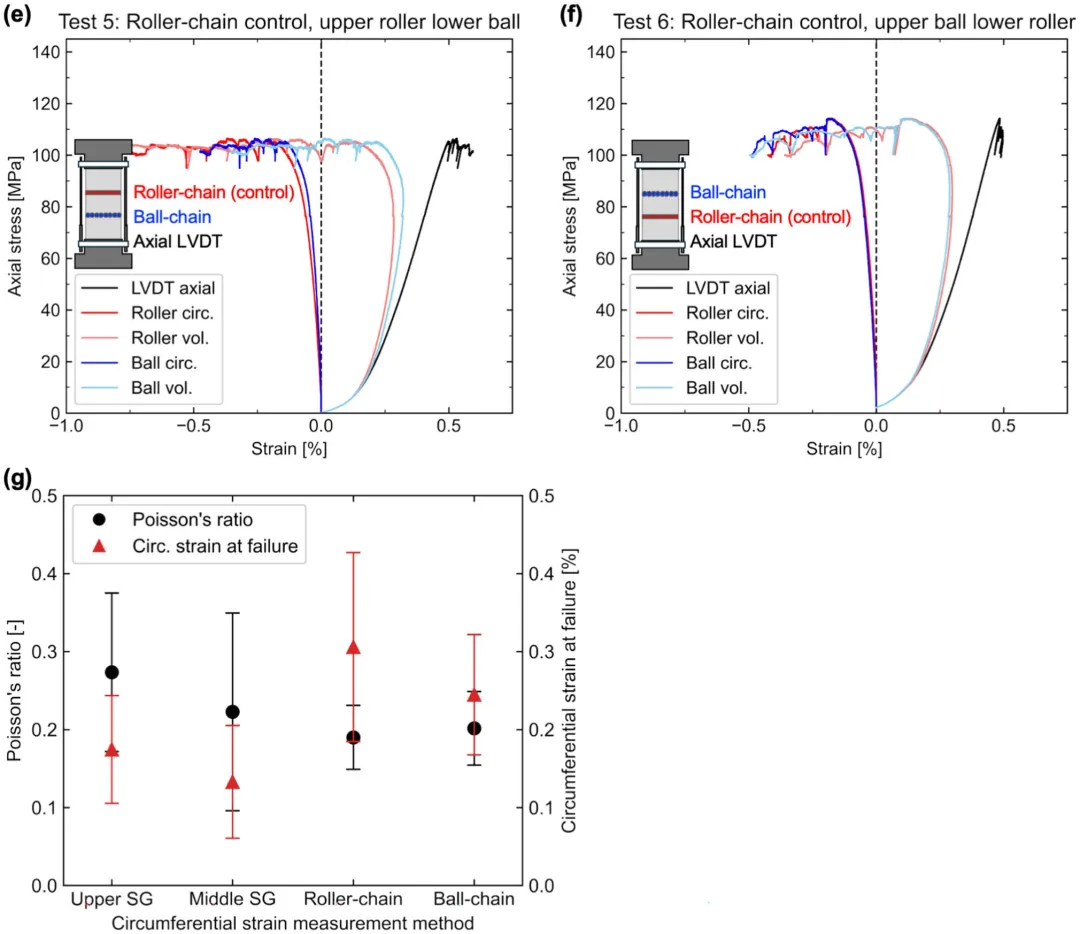
Fig. 2 Stress–strain curves for Beishan granite samples subjected toaxial compressive loading servo-controlled by (a and b) LVDT-measured axial displacement, (c and d) ball-chain extensometer measuredcircumferential deformation, and (e and f) roller-chain extensometermeasured circumferential deformation. In each pair of tests, the positions of the extensometers are swapped to exclude positional bias. gCircumferential strain at failure (red triangles) and Poisson’s ratio(black circles) calculated from circumferential strain measurementsobtained using different methods
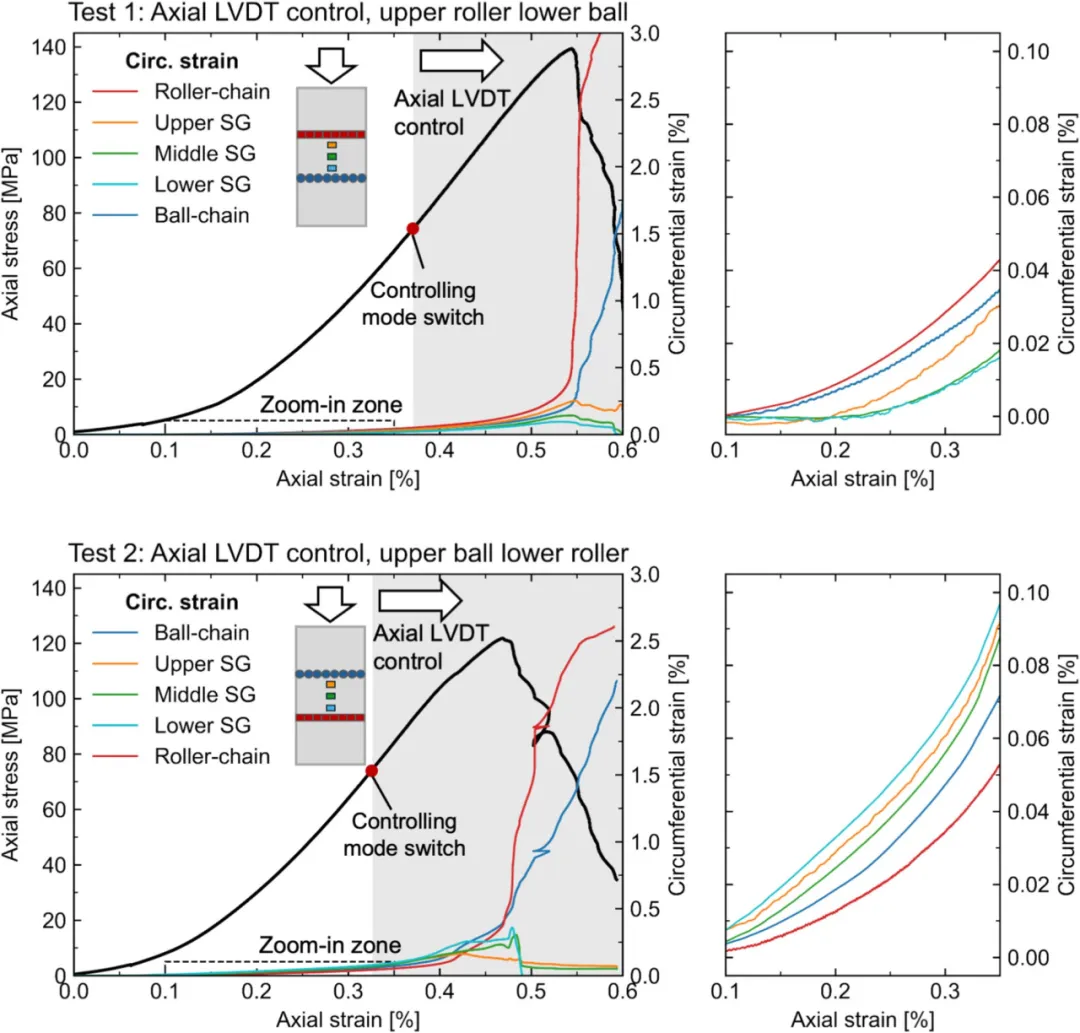
Fig. 3 Evolution of axial stress (black line) and circumferential strainmeasured by ball-chain extensometer (blue line), roller-chain extensometer (red line), and horizontal strain gauges (orange, green, andcyan lines) during the axial LVDT-controlled tests. Servo controlmode transitions from load rate control to axial LVDT-measureddisplacement control at approximately 75 MPa. The positions of theextensometers are swapped to exclude positional bias. Circumferential strain evolution in dashed rectangles is zoomed in and shown onthe right
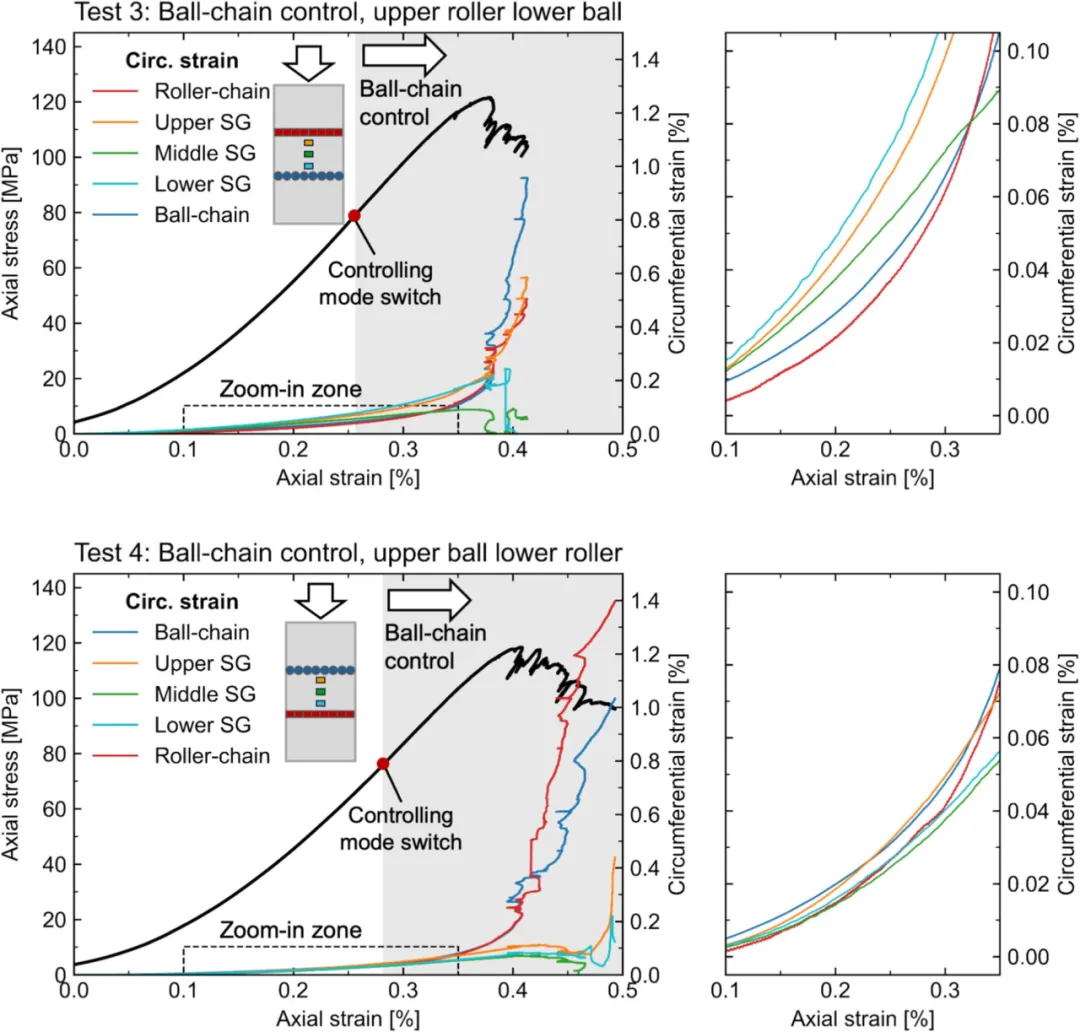
Fig. 4 Evolution of axial stress (black line) and circumferential strainmeasured by ball-chain extensometer (blue line), roller-chain extensometer (red line), and horizontal strain gauges (orange, green, andcyan lines) during the ball-chain circumferential extensometer-controlled tests. Servo control mode transitions from load rate control toball-chain extensometer-measured circumferential deformation control at approximately 75 MPa. The positions of the extensometers areswapped to exclude positional bias. Circumferential strain evolutionin dashed rectangles is zoomed in and shown on the right
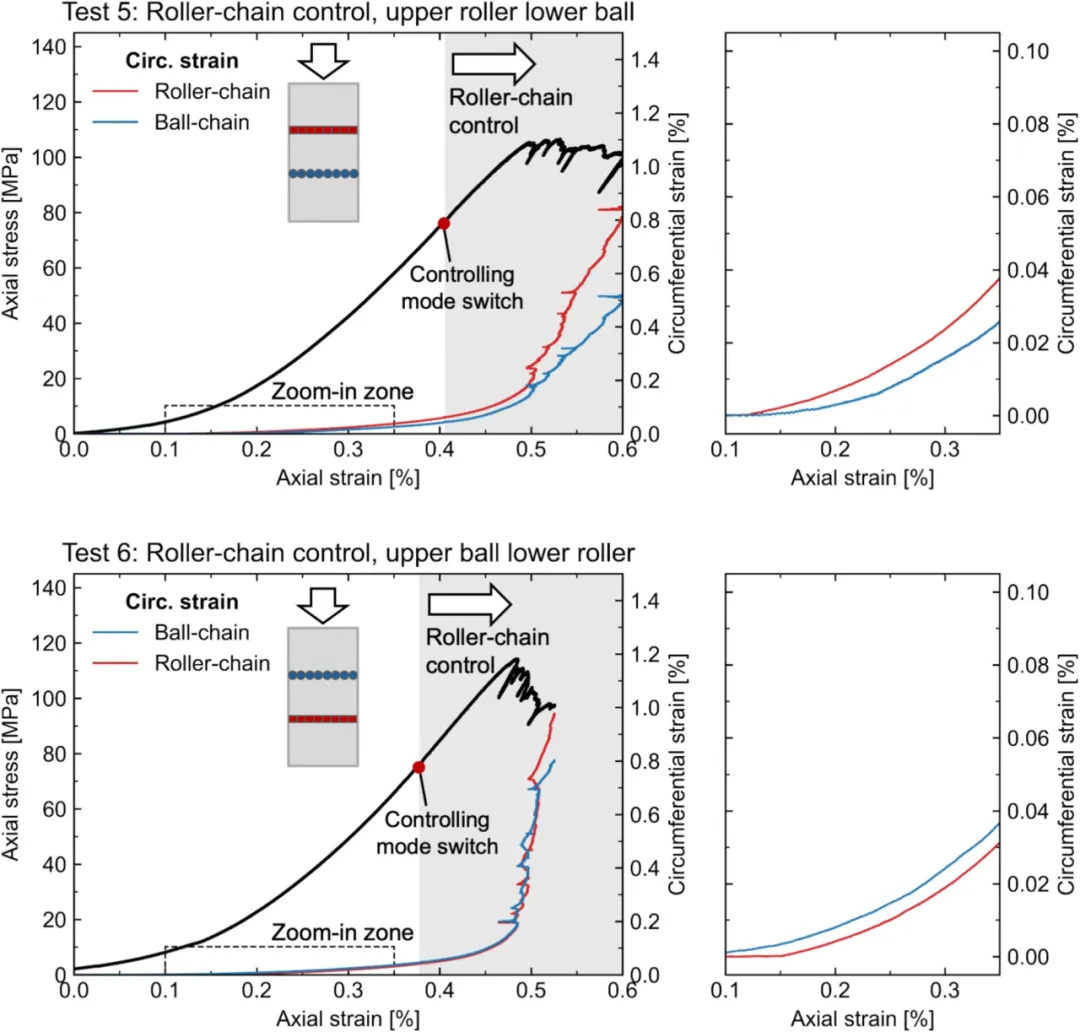
Fig. 5 Evolution of axial stress (black line) and circumferential strainmeasured by ball-chain extensometer (blue line) and roller-chainextensometer (red line) during the roller-chain circumferential extensometer-controlled tests. Servo control mode transitions from loadrate control to roller-chain extensometer-measured circumferentialdeformation control at approximately 75 MPa. The positions of theextensometers are swapped to exclude positional bias. Circumferential strain evolution in dashed rectangles is zoomed in and shown onthe right
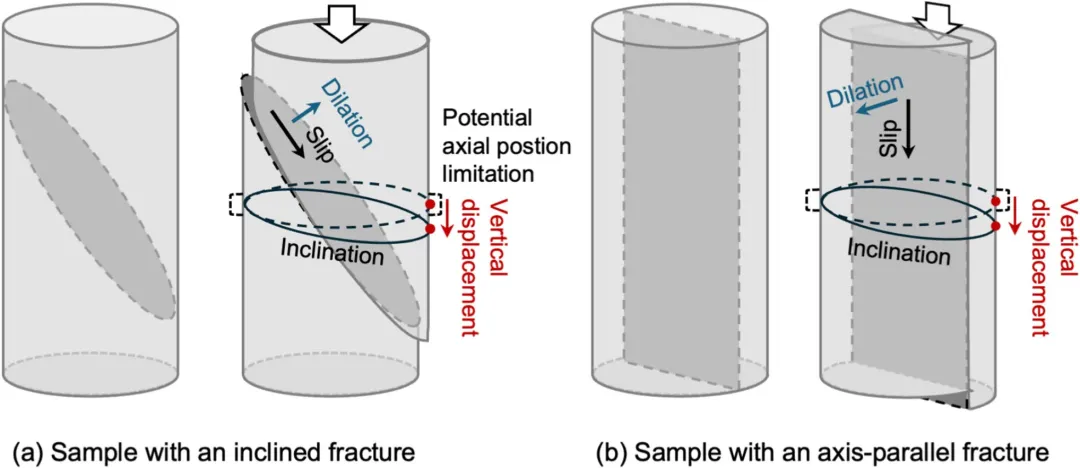
Fig. 6 Two typical experimental configurations for large-deformationregimes: a inclined fracture (Ji et al. 2022b) and b parallel fracture,both prone to chain inclination. a In the inclined fracture configuration, accurate measurement of both axial displacement and circumferential deformation is required to resolve fracture dilation duringshear slip. b In the parallel fracture configuration, dilation is primarily reflected in circumferential deformation. In both cases, slip alongthe fracture induces relative block movement, distorting the chainand introducing ellipticity, which compromises the accuracy of circumferential strain measurements. The performance of the ball-chainextensometer can be further improved by mechanically constrainingits axial position to reduce inclination effects