第一作者:彭芃 博士研究生(南京大学)
通讯作者:张淑娟 教授(南京大学)
论文DOI: 10.1021/acs.est.5c14966
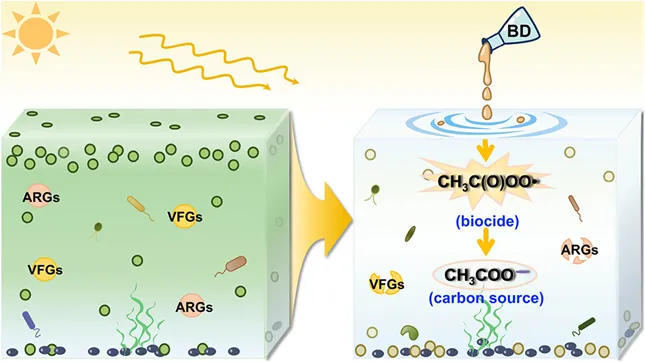
近日,南京大学张淑娟教授课题组在《Environmental Science & Technology》上发表了题为“Balanced Radical-Based Cyanobacterial Suppression and Carbon-Driven Community Shift with Butanedione in Aquatic Microcosms”的研究论文。该研究系统评估了天然化合物——丁二酮(BD)在太阳光驱动下,通过“过氧乙酰自由基高效抑藻”与“乙酸盐驱动群落良性演替”的双效机制,实现有害蓝藻水华的精准控制与水生态健康的协同提升。研究首次解耦了BD光解中间产物(过氧乙酰自由基)与终产物(乙酸盐)的独立生态效应,揭示了BD不仅能快速杀灭蓝藻并降解微囊藻毒素(MC-LR),更能通过抑制群体感应通路,显著降低水体中抗生素抗性基因(ARGs)与毒力因子基因(VFGs)的传播风险。面对全球日益严峻的有害蓝藻水华污染难题,本研究创新性地将一种天然存在、低生物富集性的化合物——BD应用于模拟真实自然水体的微宇宙系统中。研究发现,BD的施加引发了一个独特的串联生态修复过程:在初始阶段,BD光解产生的高活性过氧乙酰自由基作为“生物杀灭剂”,高效抑制蓝藻增殖并将MC-LR降解至世界卫生组织(WHO)规定的安全阈值以下;在后续阶段,其光解终产物乙酸盐作为“可利用碳源”,驱动真核藻的复苏与有益光异养细菌的富集。更为关键的是,宏基因组分析表明,BD衍生的自由基有效破坏了微生物的群体感应和细胞壁合成途径,将同时携带ARGs和VFGs的高风险细菌宿主丰度削减至单纯乙酸盐处理组的五分之一。这些发现为设计兼顾“高效靶向”与“生态安全”的新型控藻技术提供了科学基础。随着气候变化和水体富营养化的加剧,有害蓝藻水华已成为全球性的环境危机。尽管传统化学杀藻剂见效快,但常伴随非靶向毒性、破坏生态群落结构以及引发毒素释放等二次生态风险。在此背景下,利用环境友好的天然小分子进行太阳光驱动的光化学抑藻成为极具前景的替代方案。BD作为广泛存在于植物和大气中的天然物质,在阳光下可发生光解。然而,由BD光解引发的“从强效自由基向营养碳源(乙酸盐)转化”的级联反应,究竟会给复杂的微生态系统带来怎样的净生态结果?其对水体中隐蔽的健康风险(如ARGs和VFGs)有何影响?本研究通过长达26天的微宇宙实验给出了详尽解答。BD的强效抑藻性能与毒素控制
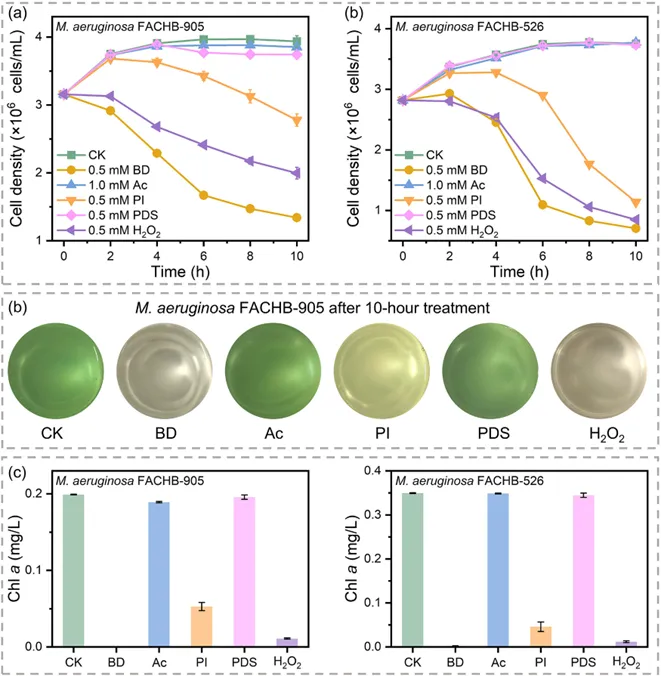
Fig. 2. Benchtop inhibitory effects of five chemicals on M. aeruginosa FACHB-905 and FACHB-526. (a) Cell density evolution profiles, (b) Photographs of culture solutions after 10 h of treatment, (c) Chl aconcentration after 10 h of treatment. CK: the control group; BD: butanedione; Ac: acetate; PI: periodate; PDS: persulfate, and H2O2: hydrogen peroxide.
对比抑藻实验表明,综合考虑抑藻效率和环境效益,BD显著优于过氧化氢、过硫酸盐和高碘酸盐等传统无机氧化剂。0.5 mM的BD在10小时内即可使高毒性铜绿微囊藻液完全褪色(叶绿素a几乎降至零)。尤其值得一提的是,尽管氧化破胞会导致MC-LR释放,但BD体系生成的活性自由基能迅速将其降解,水体中最终的毒素浓度低于WHO规定的安全阈值。微宇宙中水质参数的动态响应
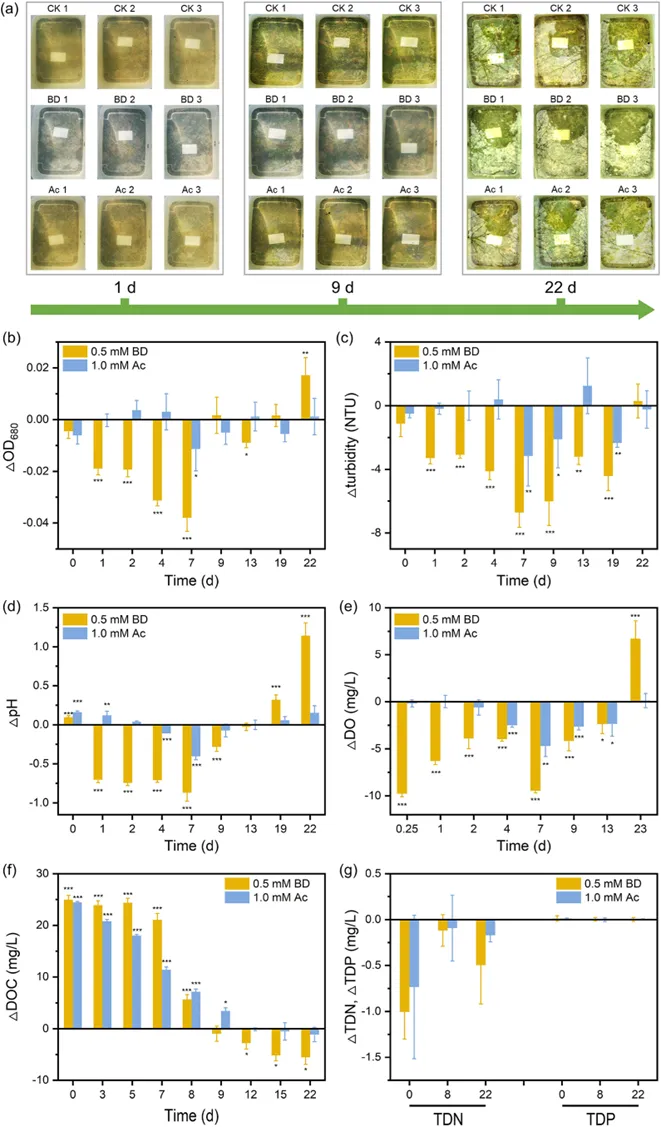
Fig. 3.Performance of BD and Ac in microecosystems. (a) Photos of the three test groups (CK, BD, Ac). (b–g) The changes in water quality parameters: OD680, turbidity, pH, DOC, TDN, TDP, and DO during the experiment, where * denotes P< 0.05, ** P < 0.01, and *** P < 0.001 compared to the control (CK). The significance analysis was conducted for BD and Ac, respectively, against CK.
在26天的模拟微宇宙实验中,BD组展现出清晰的两阶段修复轨迹:第一阶段,由自由基主导,水体浊度、生物量和溶解氧迅速下降;第二阶段(第19天后),由乙酸盐驱动,真核藻类开始竞争性生长,溶解氧及生物量良性回升。相比之下,单纯投加乙酸盐(Ac组)全程仅引起微弱的生物量增加,证明早期的强效抑藻与水质改善归功于BD衍生的过氧乙酰自由基。
抗生素抗性基因丰度削减
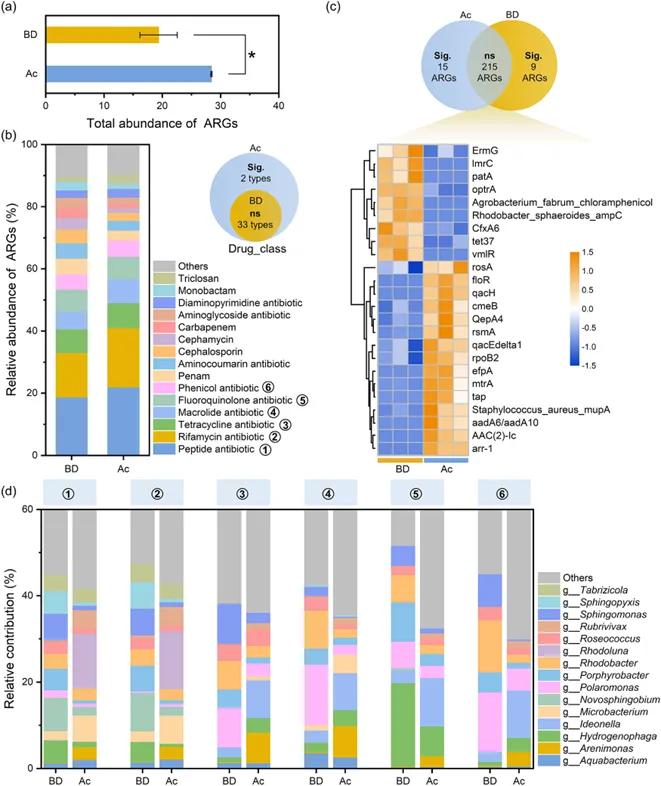
Fig. 4.(a) ARGs detected in both sample groups. (a) The total abundance of all detected ARGs in the BD and Ac groups. Here, * indicates P < 0.05. (b) Distribution and differential analysis of resistance genes at the drug_class level. The left panel shows the relative abundance proportion of the top 15 ARGs types, while the top-right panel illustrates the number of differentially abundant genes at the drug_class level─yellow representing the BD group and blue representing Ac. Significant ARGs are highlighted in the group where they are more abundant. (c) The analysis of differential ARGs at the gene level. The upper part of the figure shows the distribution of differentially ARGs between the two groups, while the lower part presents a heatmap of 24 differential ARGs. (d) The analysis of the top 15 bacterial genera with the highest contributions to the top 6 ARGs at the drug_class level.
宏基因组测序显示,与Ac组相比,BD处理显著降低了ARGs的总丰度(尤其是夫西地酸和异烟肼类耐药基因)。物种贡献分析表明,这与BD引发的群落结构重塑密切相关(例如导致放线菌门显著减少)。毒力因子基因丰度削减
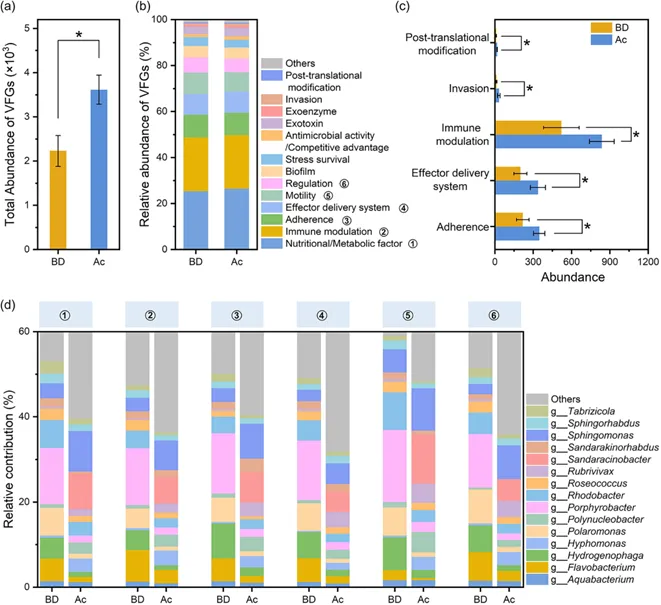
Fig. 5.Distribution of VFGs in the two water samples. (a) The total gene abundance of all detected VFGs in two groups. (b) The compositional distribution of 13 major VFG types based on 587 detected subtypes. (c) Differential VFG types and their gene abundance, with * indicating P < 0.05. (d) The species contribution analysis of 6 major VFG types. Here, the 15 bacterial genera with the highest contribution were selected.BD处理不仅降低了VFGs的总丰度,更在黏附、效应物递送系统等与病原菌定植和感染密切相关的通路表现出显著的抑制作用。结合KEGG通路分析,这主要是因为过氧乙酰自由基破坏了细菌的群体感应信号传导,降低了致病菌的生物膜形成与宿主免疫逃逸能力。高风险宿主的“靶向”清除
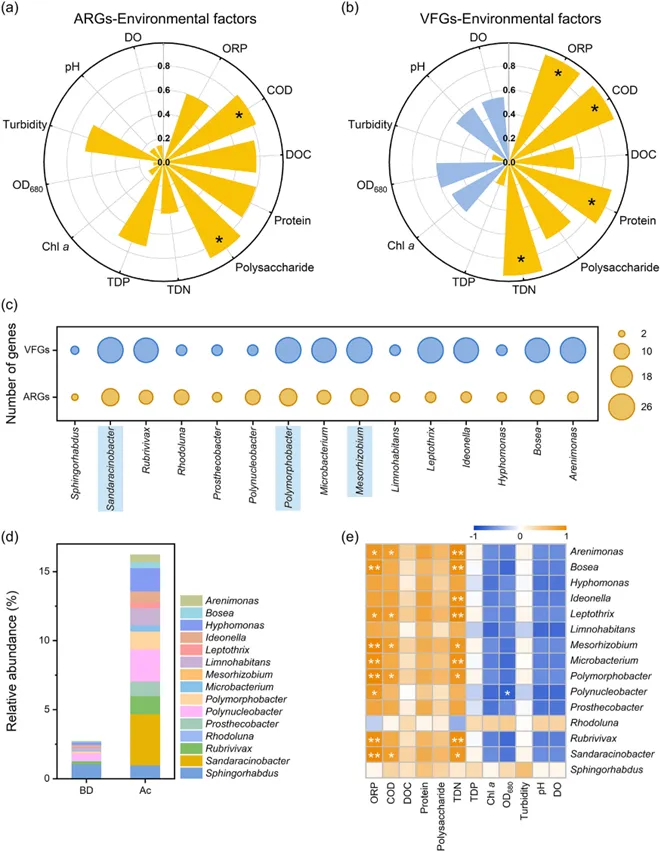
Fig. 6. Co-occurrence analysis of ARGs, VFGs, microbial community species, and water quality parameters. The correlation between the overall abundance of ARGs (a) and VFGs (b) with water quality parameters. Here, yellow indicates a positive correlation, while blue represents a negative correlation. (c) The co-occurrence analysis revealed the potential bacterial carriers of ARGs and VFGs (AVBCs) at the genus level. Here, the size of the bubbles represents the number of genes─the larger the bubble, the more genes it carries. The blue bars represent the three AVBCs with the highest number of carried genes. (d) The relative abundance of 15 AVBCs in the BD and Ac groups. (e) Heatmap of correlations between 12 environmental factors and AVBCs. where * denotes P< 0.05 and ** P < 0.01.共现网络分析发现,化学需氧量(COD)是驱动ARGs和VFGs富集的关键共性因子。通过共线分析,识别出15个同时携带多种ARGs和VFGs的高潜在风险细菌属(如Sandaracinobacter和Mesorhizobium)。值得注意的是,BD组中这15类“双毒”宿主的相对总丰度仅为Ac组的1/5。这一结果表明BD在维持水体健康、切断深层生态与公共卫生风险链条方面具有重要作用。这项工作阐明了BD在控制蓝藻水华中的双效机制:从“杀灭性自由基”到“生物可利用碳源”的光化学转化,创造了一个两阶段生态修复过程。BD不仅在初期通过自由基生成实现高效的蓝藻控制和水质改善,更在后期通过碳源驱动微生物群落演替促进生态系统的自我恢复。这一研究为将天然小分子双酮工程化应用于蓝藻水华治理奠定了科学基础。张淑娟:教授、博士生导师,现任职于南京大学环境学院。国家杰出青年科学基金、优秀青年科学基金获得者。先后入选教育部"新世纪优秀人才支持计划"、江苏省"双创人才引进计划"、江苏省"六大人才高峰支持计划"、国家自然科学基金"优秀青年科学基金"、南京大学"登峰人才支持计划"。主要研究方向包括环境功能材料和高级氧化还原技术,提出并系统研究了基于小分子双酮的水污染控制化学。彭芃:南京大学环境学院博士研究生,研究方向为小分子双酮介导的有害藻华控制研究。以第一作者在Environmental Science & Technology、Science of The Total Environment期刊发表SCI论文2篇。Peng, P.; Xu, J. M.; Zhang, S. J. Balanced Radical-Based Cyanobacterial Suppression and Carbon-Driven Community Shift with Butanedione in Aquatic Microcosms. Environ. Sci. Technol. 2026https://pubs.acs.org/doi/10.1021/acs.est.5c14966









 10个月宝宝每天需要喝多少奶粉?

