南京邮电大学汪联辉&苏邵&朱丹‖【Biosens Bioelectron】CRISPR驱动的DNA四面体介导传感界面用于猴痘病毒超灵敏检测
- 2026-10-09 15:29:55
点击蓝字

关注我们
介绍 /Introduction
研究图文/Introduction
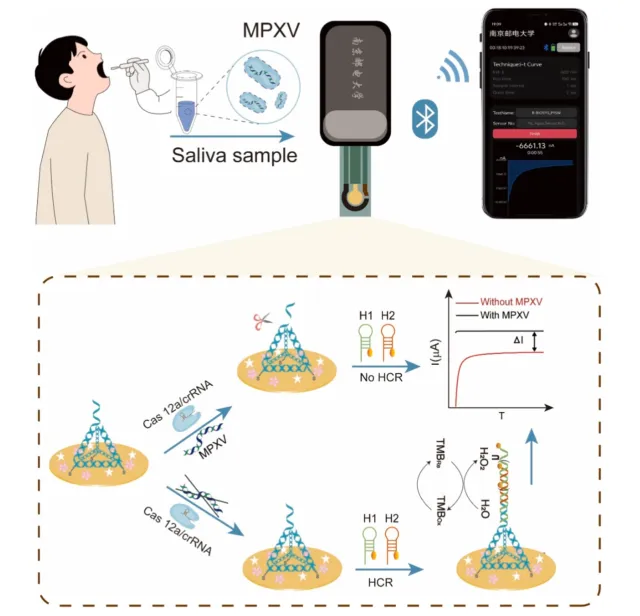
Scheme 1. Schematic illustration of a CRISPR-driven electrochemical biosensor for POCT detection of MPXV.

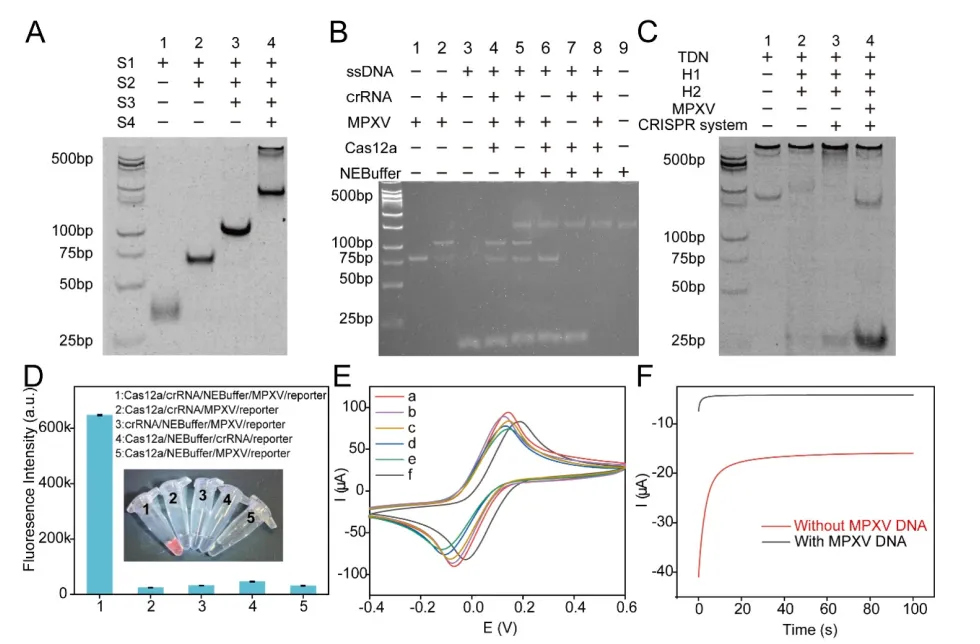
Fig. 1. (A) Polyacrylamide gel electrophoresis (PAGE) analysis of DNA tetrahedron (TDN) assembly. (B) PAGE analysis of the TDN-triggered hybridization chain reaction (HCR). (C) PAGE and (D) fluorescence spectra demonstrated the trans-cleavage activity of the CRISPR-Cas12a system. (E) Cyclic voltammetry (CV) curves of (a) SPCE-HFGNs, (b) TDN/SPCE-HFGNs, (c) MCH/TDN/SPCE-HFGNs, (d) BSA/MCH/TDN/SPCE-HFGNs, (e) H1+H2/BSA/MCH/TDN/SPCE-HFGNs, and (f) H1+H2/BSA/MCH/Cas12a-crRNA-MPXV DNA/TDN/SPCE-HFGNs in 5 mM [Fe(CN)6]3-/4- solution containing 0.1 M KCl. Scan rate: 100 mV s- 1. (F) Chronoamperometric responses of the biosensor with and without MPXV DNA.

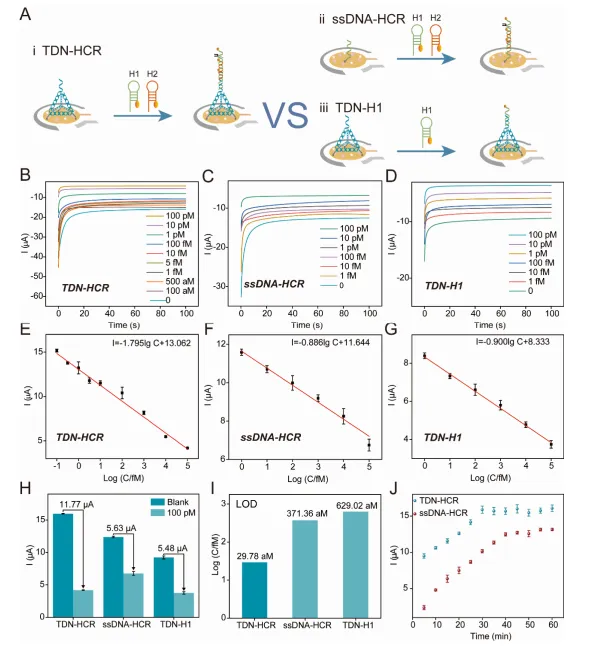
Fig. 2. (A) Schematic illustration of three CRISPR-driven sensing strategies for MPXV DNA detection (i) TDN-HCR, (ii) ssDNA-HCR, and (iii) TDN-H1. Chronoamperometric responses of three CRISPR-driven sensing strategies (B) TDN-HCR, (C) ssDNA-HCR, and (D) TDN-H1 for detecting different concentrations of MPXV DNA. Calibration curves of (E) TDN-HCR, (F) ssDNA-HCR and (G) TDN-H1 for different concentrations of MPXV DNA detection. (H) ΔI of three CRISPR-driven sensing strategies for 100 pM MPXV DNA detection. (I) The corresponding LODs obtained from three sensing strategies. (J) Kinetic curves of TDN and ssDNA sensing interface for the trigger of HCR.
结论 /Conclusion
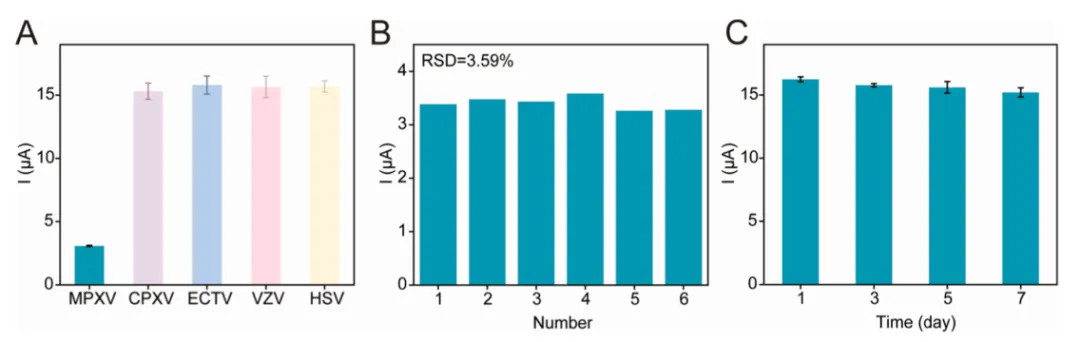
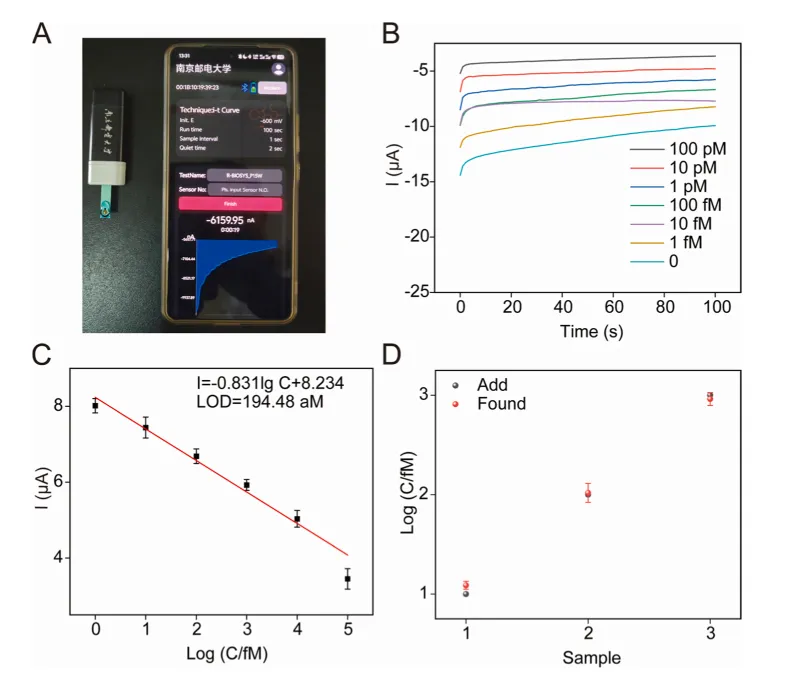
该传感器整合了CRISPR/Cas12a系统、四面体DNA纳米结构传感界面和杂交链式反应信号放大策略。得益于SPCE-HFGNs(分级花状金纳米结构修饰的丝网印刷碳电极)的高导电性和比表面积、TDN的三维定向调控能力以及HCR的无酶信号放大效应,该传感器展现出宽动态范围(1 fM – 100 pM)、超低检测限(194.48 aM)、快速检测速度(30分钟内达到电流平台)、高重现性(RSD=3.59%)和优异的储存稳定性(7天后保持93%初始信号)。更重要的是,通过与便携式电化学设备和智能手机结合,该传感器成功实现了在10%人唾液中的加标回收实验,回收率在98.7%–108.8%之间,RSD小于5%,证明了其在实际样本中的POCT应用潜力。总体而言,这项工作为猴痘病毒的超灵敏现场检测提供了一个多功能且强大的平台,对传染病的早期诊断具有广阔的前景。
文献直通车 /Literature information
Ultrasensitive detection of monkeypox virus: harnessing synergistic CRISPR-driven signal amplification on a DNA tetrahedron-mediated sensing interface
Tianchen Du, Feng Ding, Xiaoxin Ma, Yi Luo, Dan Zhu,* Lianhui Wang,* Shao Su* Biosensors and Bioelectronics, Volume 298, 2026, 118441
原文链接:https://doi.org/10.1016/j.bios.2026.118441
点击左下角“阅读原文”,轻松获取原文信息
欢迎扫码关注
科研路上,我们一路同行!
免责声明
「原创」仅代表原创编译,水平有限,仅供学术交流,本平台不主张原文的版权,如有侵权,请联系删除。文献解读或作者简历如有疏漏之处,我们深表歉意,请作者团队及时联系chemsensing@163.com,我们会在第一时间进行修改或撤稿重发,感谢您的谅解!

END


投稿、荐稿、合作请联系邮箱
chemsensing@163.com





随机文章
-
 10个月宝宝每天需要喝多少奶粉?
- 南京招聘|江宁区开市客促销兼职,220元/天
- 毕业季,又被南京地铁的限定播报戳心了
- 南京市玄武区花店可以提供:南京市玄武区送花、南京市玄武区生日鲜花预定、开业花篮预定服务,
- 秦淮水亭访文木——南京吴敬梓纪念馆游记
- 第160天|南京青年书家笔下的2026
- (纯计算)南京航空航天大学仇虎团队Phys. Rev. Lett.: 无图案化二维晶体表面上的一维布朗运动
- 关于撤销南京电视台影视频道、少儿频道和南京人民广播电台城市管理广播的公告
- 南京大屠杀惨事:七月孕妇被捅三十七刀,竟奇迹般绝处逢生
- 南京人的“精神氧舱”升级了!地铁无缝对接,这个宝藏公园巨树成荫,与高端颐养中心一墙之隔,周末充电首选.
- 最后能帮大家梳理一下知识点和答题方法,南京中考数学速进!

