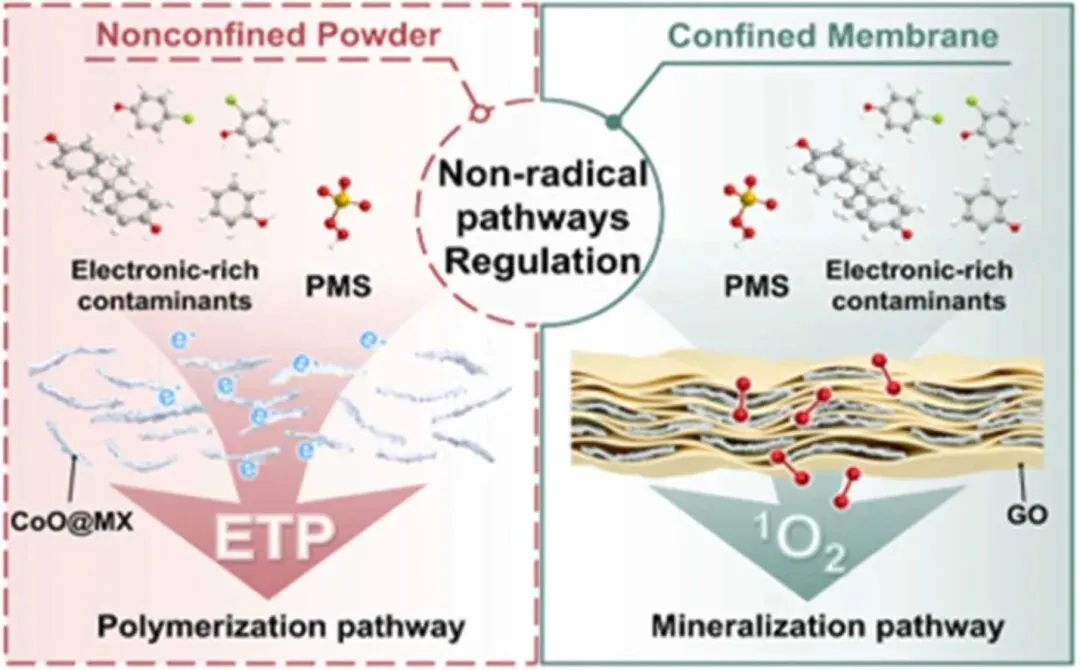
在此,我们证明了层状催化膜内的空间限制能够有效地将NRDPs的反应机制从ETP切换为以1O2为主的机制。该膜通过将钴修饰的MXene纳米片(CoO@MX)插层到氧化石墨烯(GO)层状结构中制备而成,形成了结构明确的二维纳米通道。与主要通过ETP激活PMS的CoO@MX粉末不同,该局域化膜体系更倾向于产生1O2,这已通过电子顺磁共振、原位荧光和密度泛函理论计算得到证实。这种反应路径的转换,结合受限环境加速的质量传输,使该膜在通过过一硫酸盐活化降解酚类化合物时的反应速率常数(0.093 ms⁻¹–0.127 ms⁻¹)比传统粉末催化剂高出四个数量级。此外,在单程过滤模式下,即使在腐殖酸存在的情况下,该膜在仅 68 ms 的超短水力停留时间下,也能几乎完全(约 95%)去除磺胺甲噁唑。这项工作为调节 NRDP 提供了新策略,并为设计用于复杂水处理的高效、高选择性先进氧化系统开辟了道路。
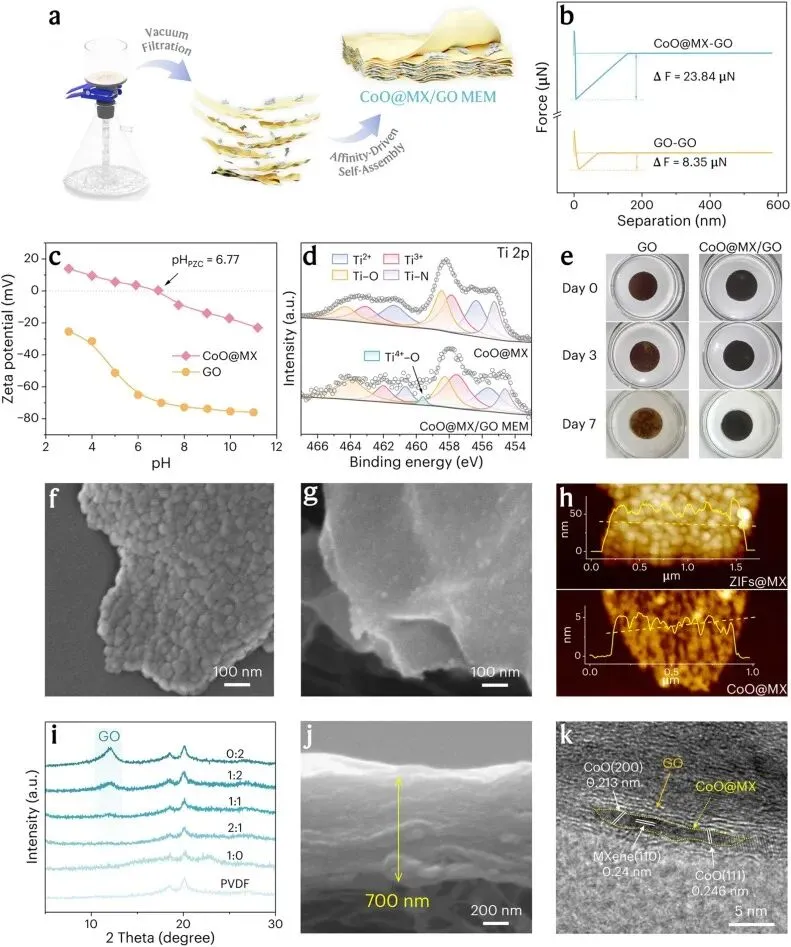
Fig. 1. (a) Schematic diagram of the CoO@MX/GO membrane assembly. (b) Interfacial AFM Force Curves. (c) Zeta potential of CoO@MX and GO. (d) XPS spectra of CoO@MX and CoO@MX/GO membrane. (e) Photos of GO and CoO@MX/GO membrane after immersion in water for 0, 3, and 7 days. (f, g) SEM image of ZIFs@MX and CoO@MX. (h) AFM image and corresponding height profile. (i) XRD patterns of membranes with different mass ratios. (j) Cross-sectional SEM image of CoO@MX/GO membrane. (k) Cross-sectional HRTEM image of CoO@MX/GO membrane.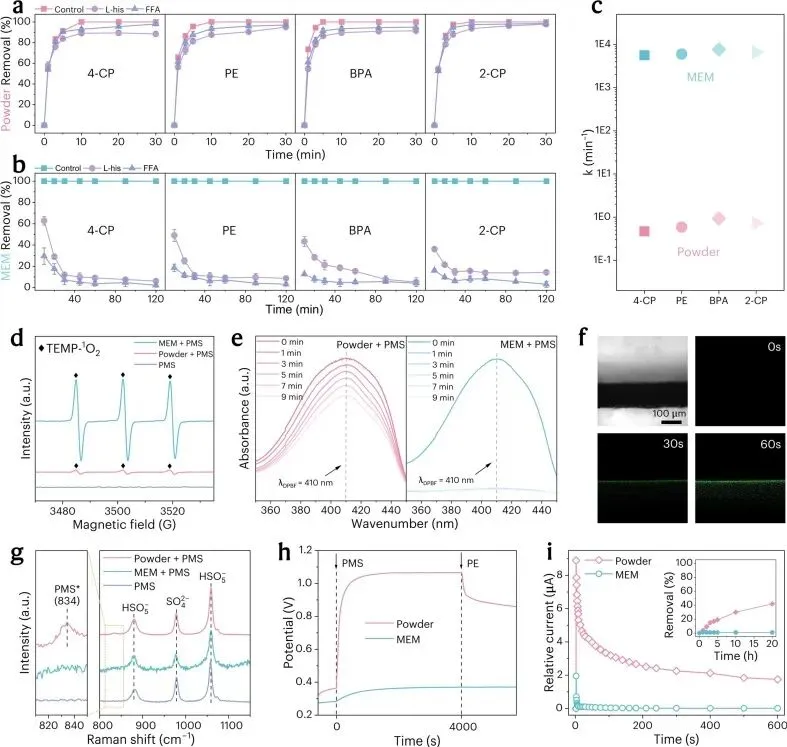
Fig. 2. (a) Quenching experiments of the powder systems. (b) Quenching experiments of the membrane systems. (c) The k values of different systems. (d) EPR spectra for 1O2 in different systems. (e) UV–vis spectra of DPBF in different systems. (f) Bright-field and fluorescence images of the CoO@MX/GO membrane in the PMS system at different reaction times. (g) In situ Raman spectra of different systems. (h) Variation of OCP for different systems. (i) Current flowing from PMS cell to the pollutant cell in GOS. Error bars represent the standard deviation, obtained by repeating the experiment twice. Reaction condition: [PCs] = 10 mg L–1, [L-his] = 10 mM, [FFA] = 10 mM, [PMS] = 0.64 mM, [catalysts] = 0.04 g L–1, [TEMP] = 25 mM, T = 25 ºC, initial pH = 3.7.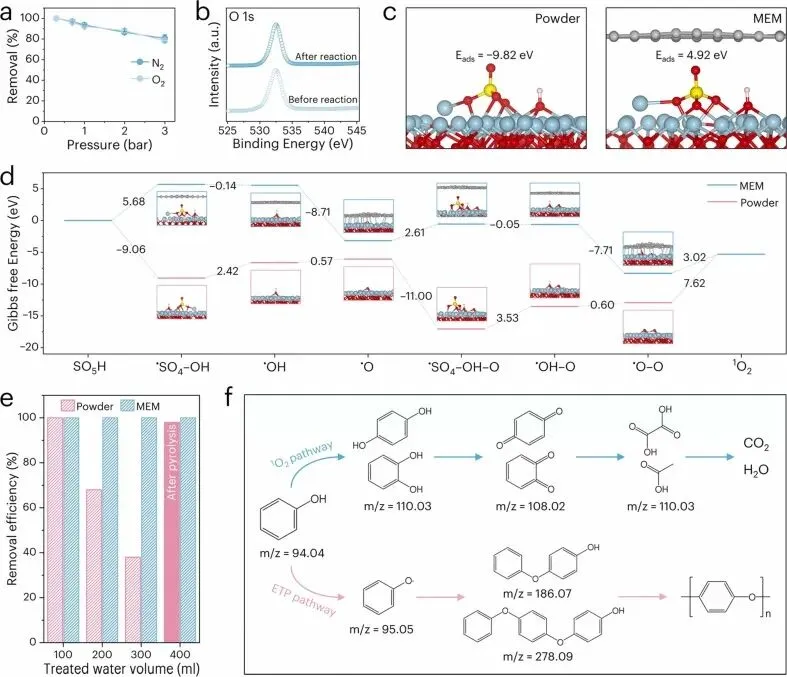
Fig. 3. (a) Removal of PE in membrane system under different atmospheres. (b) O 1 s XPS spectra of membrane before and after reaction. (c) The difference in adsorption energy of PMS molecules before and after adsorption on powder/membrane systems. (d) Formation pathway of 1O2 in membrane system. (e) The removal of PE by the powder/ membrane systems with the volume of water removed. (f) Possible degradation pathways of two systems. Error bars represent the standard deviation, obtained by repeating the experiment twice. Reaction condition: [PCs] = 10 mg L–1, [catalysts] = 0.04 g L–1, [PMS] = 0.64 mM, T = 25 ºC, initial pH = 3.7.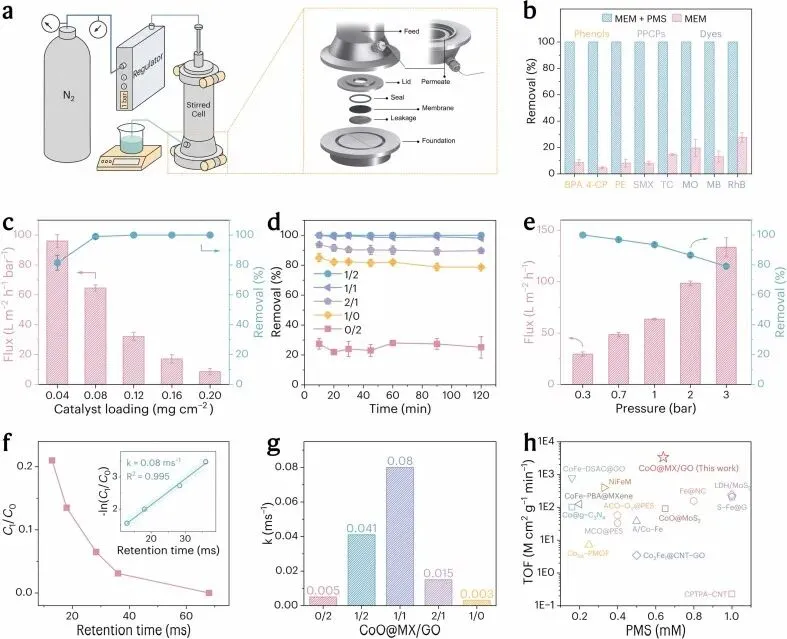
Fig. 4. (a) Schematic illustrating the dead–end filtration system. (b) Removal of various pollutants by the membrane. (c) Removal and flux at different catalyst loadings. (d) Removal of different membranes. (e) Removal and flux at different pressure. (f) Relationship between SMX concentration (C1 and C0 correspond to SMX concentrations in the permeated solution and feed solution, respectively) and retention time (inset: pseudo-first-order rate constant of SMX removal). (g) Pseudo-first-order rate constant of different membranes. (h) Comparison of the TOF of different systems. Error bars represent the standard deviation, obtained by repeating the experiment twice. Reaction condition: [Pollutants] = 10 mg L–1, [PMS] = 0.64 mM, T = 25 ºC, initial pH = 3.7.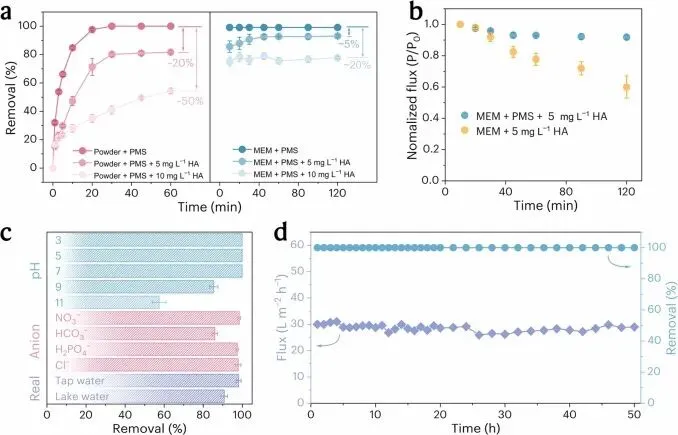
Fig. 5. (a) Removal of SMX by different systems. (b) Variation in normalized flux of the membrane in the presence and absence of HA. (c) Removal of SMX by the membrane under interference from different samples. (d) Removal and flux variations with running time. Error bars represent the standard deviation, obtained by repeating the experiment twice. Reaction condition: [Pollutants] = 10 mg L–1, [PMS] = 0.64 mM, [anion] = 10 mM, T = 25ºC, initial pH = 3.7.本研究证实,在层状二维膜纳米通道内建立空间纳米限制效应,可作为调控非自由基PMS活化的有效手段,从而实现从表面介导的ETP途径向以1O2为主导的途径的转换。与粉末催化剂相比,该催化膜展现出的降解动力学速率快达四个数量级,将酚类物质的转化过程从表面滞留/低聚化转向亲电加成和开环反应,从而为减少难降解副产物的持续积累提供了可能。其对常见背景组分的耐受性,加上在低金属释放条件下长期稳定的运行能力,凸显了其在复杂水体中应用的潜力。总体而言,这些发现凸显了纳米限制作为一种有效策略,既能引导反应机理,又能将反应路径控制与膜分离相结合,为在复杂水体中开发适应性强、高效且耐用的氧化平台提供了通用设计原则。
Yunlong Wang, Xin Guo, Kechen Gu, Chengming Xiao, Wenbo Yang, Chuyan Deng, Junwen Qi, Yujun Zhou, Zhigao Zhu, Yue Yang, Jiansheng Li, Lamellar CoO@MXene/GO membrane switches non-radical pathway from electron transfer to singlet oxygen for ultrafast water decontamination, Applied Catalysis B: Environment and Energy, 2026, https://doi.org/10.1016/j.apcatb.2026.126923
声明:本公众号仅分享前沿学术成果,无商业用途。如涉及侵权,请立刻联系公众号后台或发送邮件,我们将及时修改或删除!
邮箱:Environ2022@163.com


 10个月宝宝每天需要喝多少奶粉?

