南京林业大学陈振Org. Lett.:氟代吖啶d‑HAT催化实现非活化烷烃的偕二氟烯丙基化反应
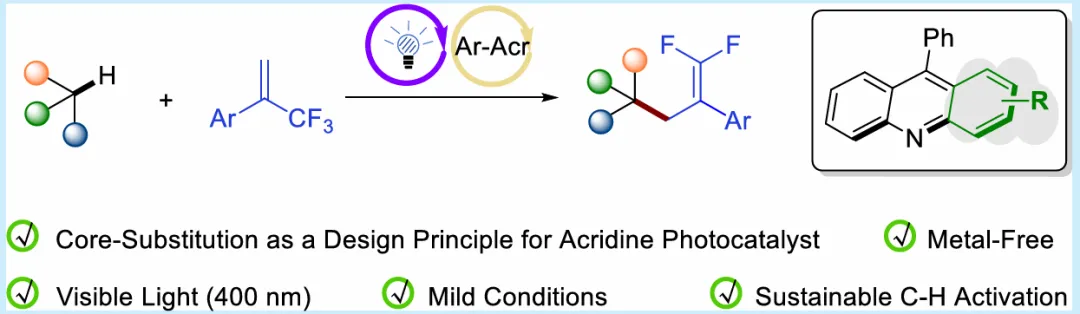
图1. TOC (图片来源于Org. Lett.)
摘要:
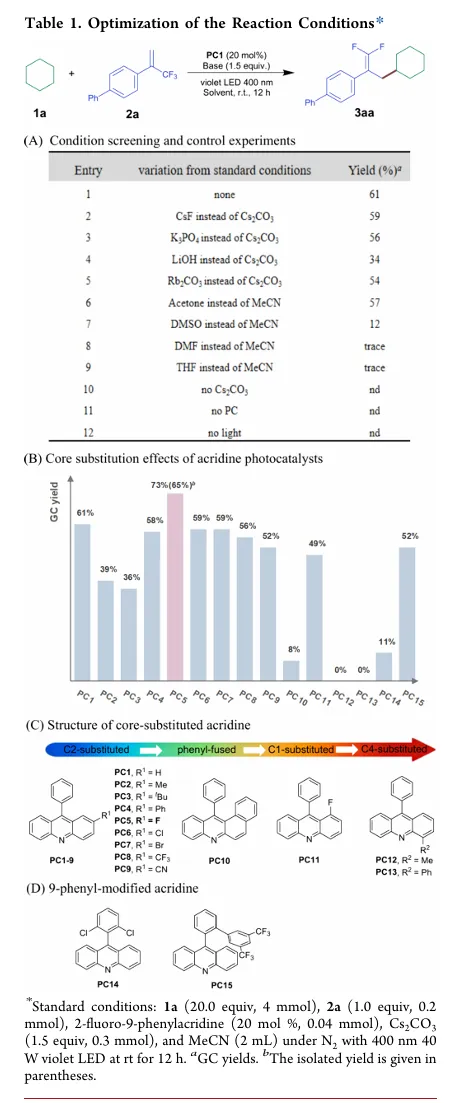
Herein, we report a metal-free gem-difluoroallylation of unactivated alkanes enabled by core-fluorinated acridine d-HAT catalysis. Systematic catalyst evaluation reveals that substitution at the acridine core profoundly influences reactivity, with a 2-fluoro substituent providing optimal performance. The transformation proceeds under mild conditions and affords gem-difluoroalkenes with a broad substrate scope. Mechanistic studies support a radical pathway involving hydrogen atom transfer and subsequent β-fluoride elimination. These findings establish acridine core engineering as a general strategy for nitrogen-centered d-HAT catalysis.
研究背景:
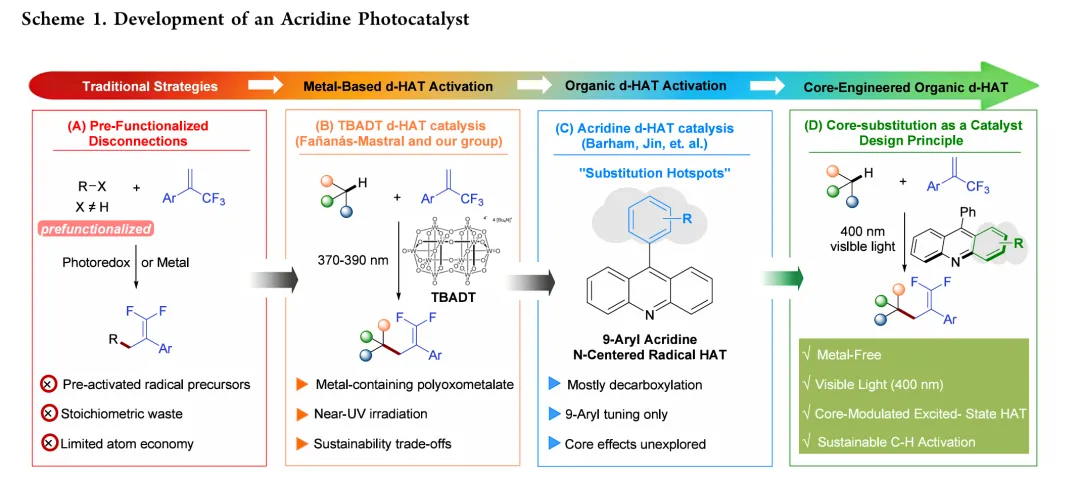
图2. 吖啶光催化发展 (图片来源于Org. Lett.)
研究内容:
图3. 反应进展 (图片来源于Org. Lett.)
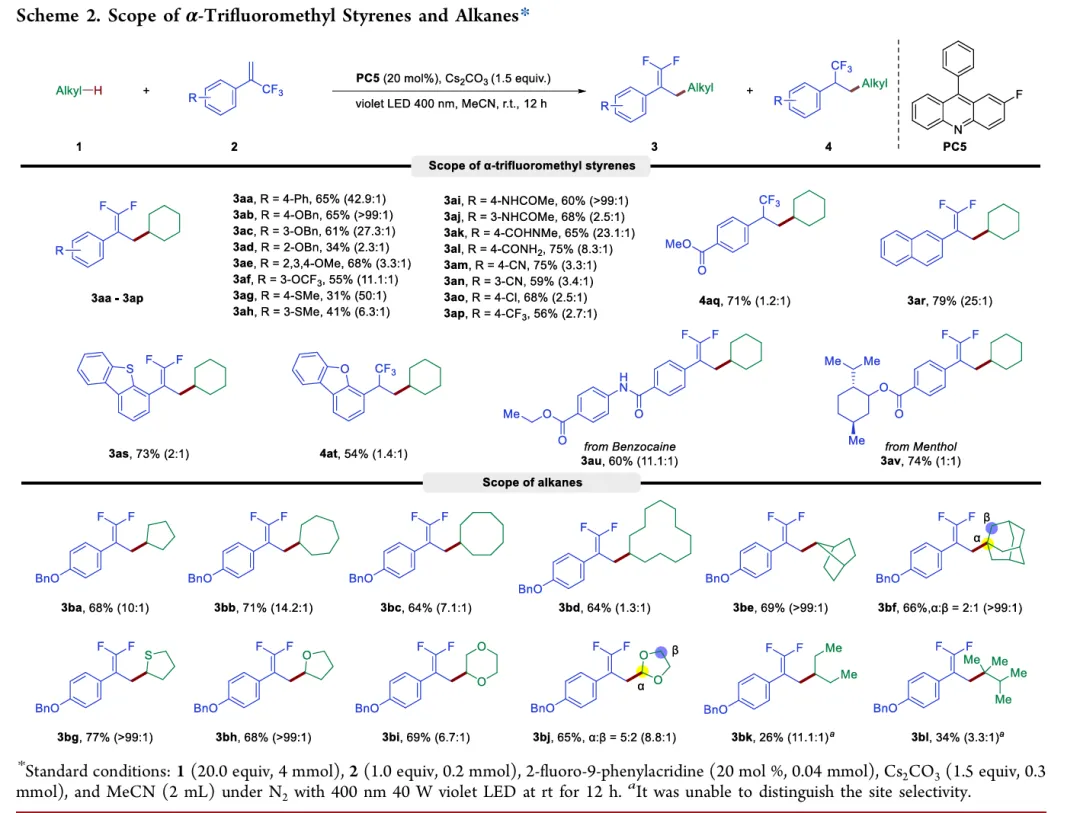
图4. α-三氟甲基苯乙烯和烷烃底物范围 (图片来源于Org. Lett.)
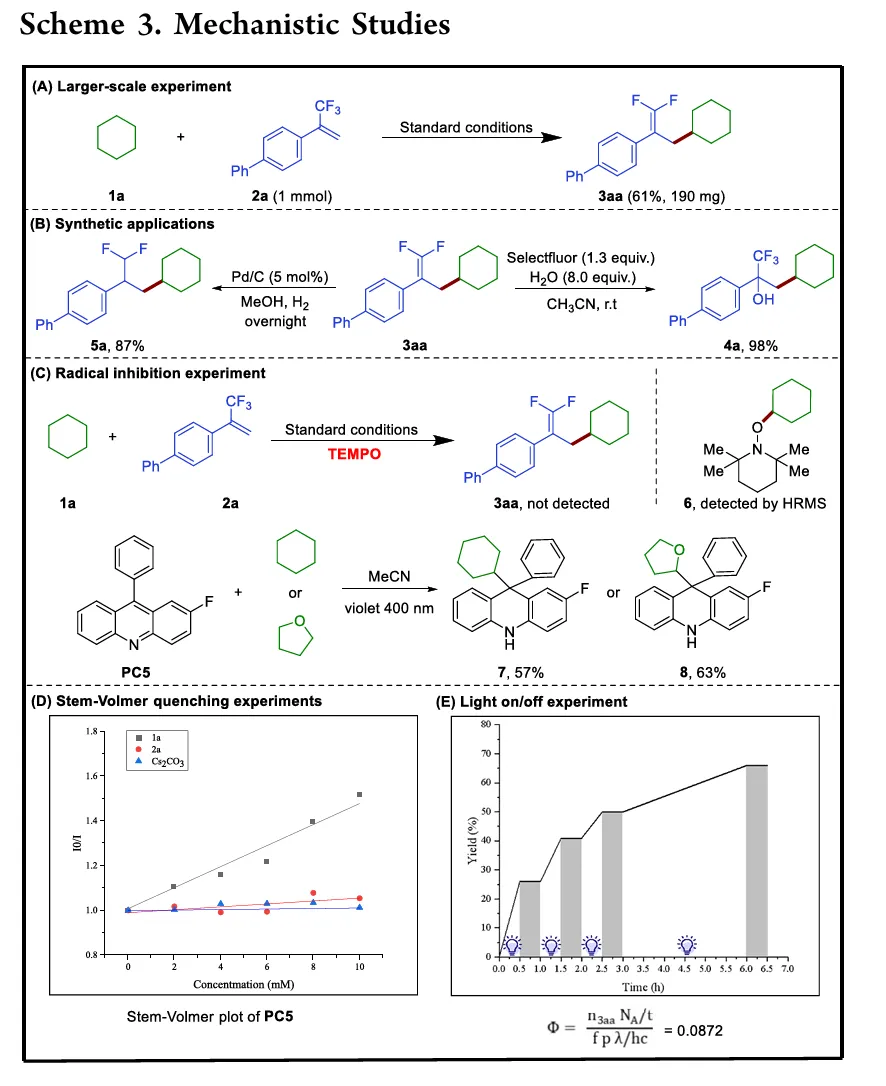
图5. 机理研究 (图片来源于Org. Lett.)
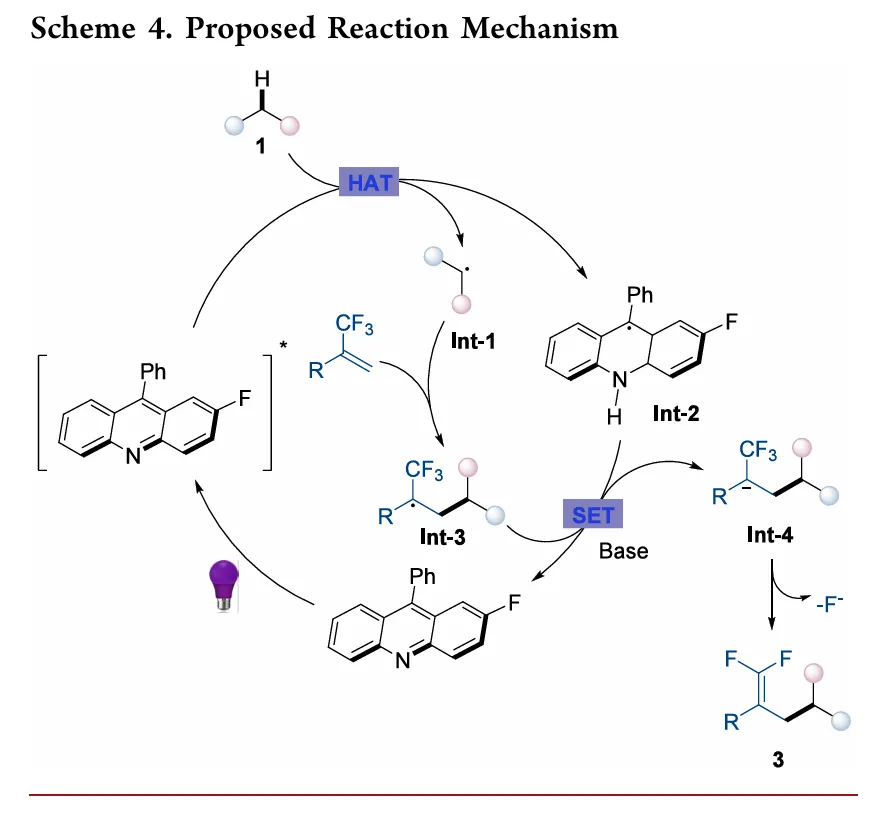
图6. 可能的催化循环 (图片来源于Org. Lett.)
总结:
In summary, we have developed a metal-free, visible-light-induced gem-difluoroallylation of unactivated alkanes using a core-fluorinated acridine photocatalyst. Systematic catalyst evaluation reveals that substitution on the acridine core profoundly influences the d-HAT efficiency, with 2-fluoro-9-phenylacridine identified as uniquely effective. The transformation proceeds under mild conditions and exhibits a broad substrate scope and good chemoselectivity. Mechanistic studies support a radical pathway involving hydrogen atom transfer and a subsequent single-electron transfer. These findings establish acridine core modification as a key design element in nitrogen-centered HAT catalysis and provide a concise strategy for direct C(sp3)−H gem-difluoroallylation.
文献信息:
DOI: https://doi.org/10.1021/acs.orglett.6c01553